Website
http://www.worldofawe.net/
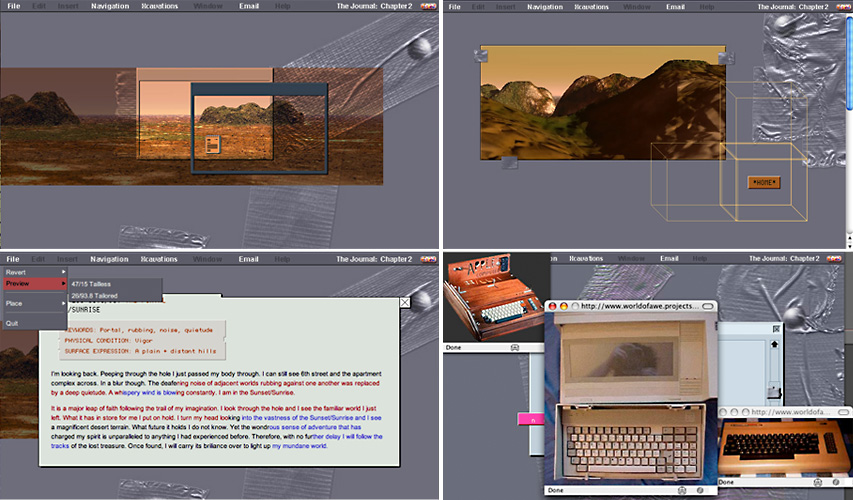
The second chapter of World of Awe: A Traveler's Journal, Destruction & Mending was commissioned and exhibited at the San Francisco Museum of Modern Art. The chapter employs a bomb graphic icon and the photographic pearl to carry the theme of destruction and mending.
Website
http://www.worldofawe.net/
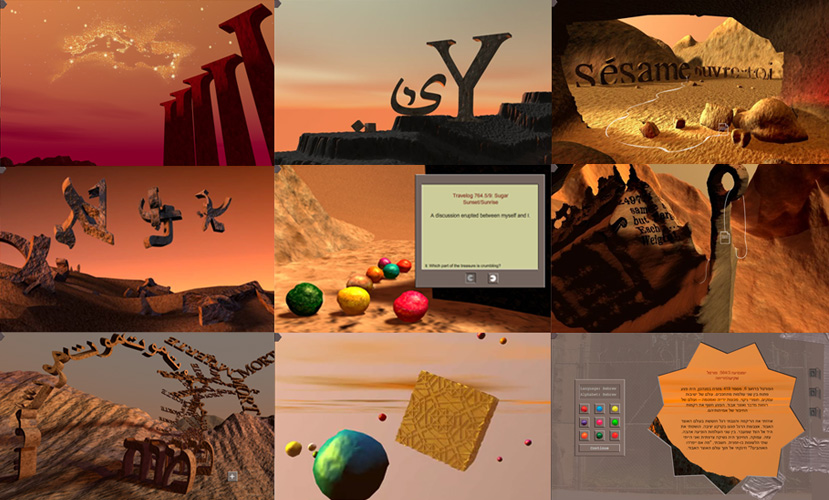
Object of Desire is a departure from the first two chapters of World of Awe: A Traveler's Journal. Made up of 15 scenes, animated in 3D and executed in Flash, the narrative is presented in three languages: English, Hebrew, and Arabic (appearance for French, Italian, and Spanish). The work marks the burgeoning interest in the Internet as an endless polyglot space.
Object of Desire explores early literary themes and motifs born in the Middle East and Mediterranean cultures that are still vibrant in contemporary culture. Biblical themes and legends receive a new treatment that take into consideration the digital advancement, in the same nostalgic and romantic voice identified with the traveler.
Funded by the Rockefeller Media grant and the MFA program at RPI, Object of Desire was exhibited among other places at The Jewish Museum in New York and EMST Museum in Athens.
Reclaimed wood, Atari joystick, button, laptop, projector, and LCD screen.
Collection of the EMST museum in Athens, Greece
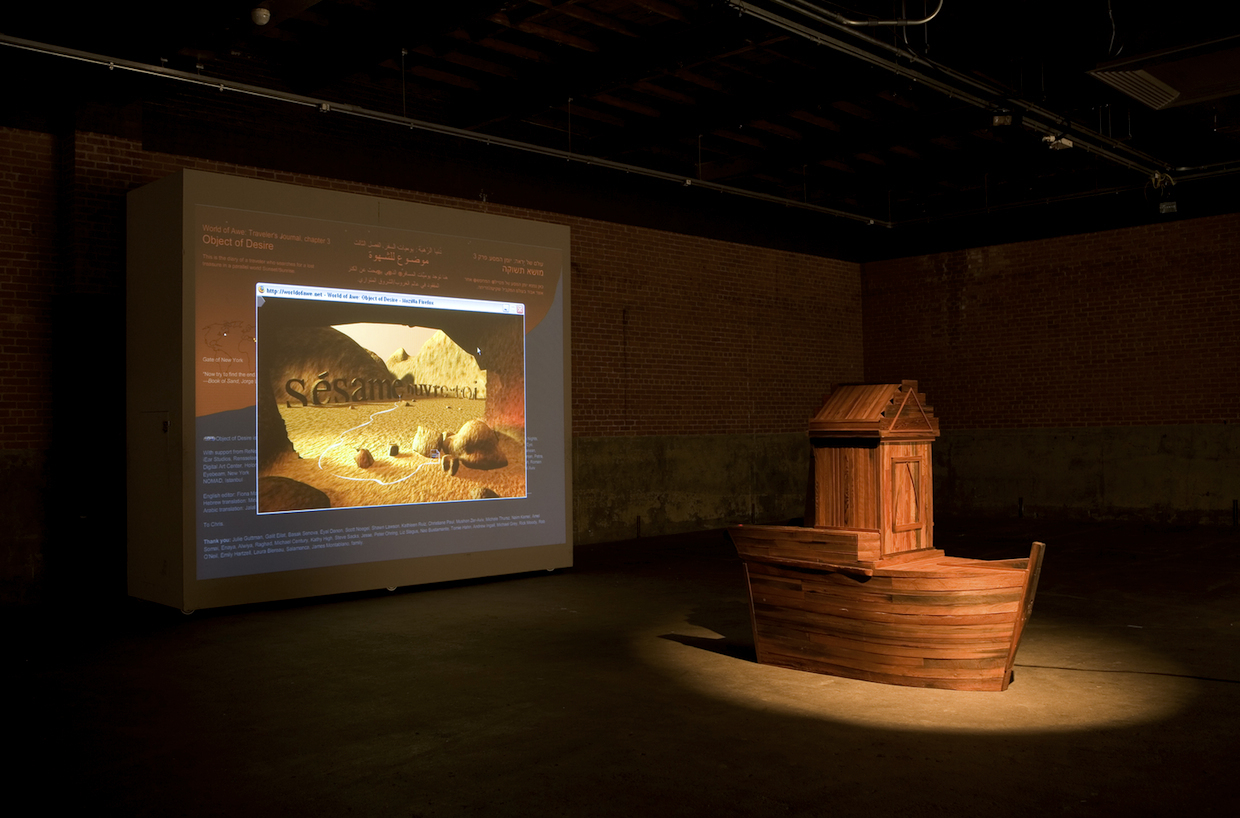
Interactive installation of Chapter 3, Object of Desire. The ark chair is based on an image of a Noah's ark toy from the 1895 Montgomery Ward & Co. Catalogue and Buyer's Guide. To navigate the website, one uses an original Atari joystick built into the left arm and a red button built into the right.
The work was created for the one-person Media Center exhibition at the Jewish Museum, 2007.
Website with Flash and audio
http://turbulence.org/Works/yael/
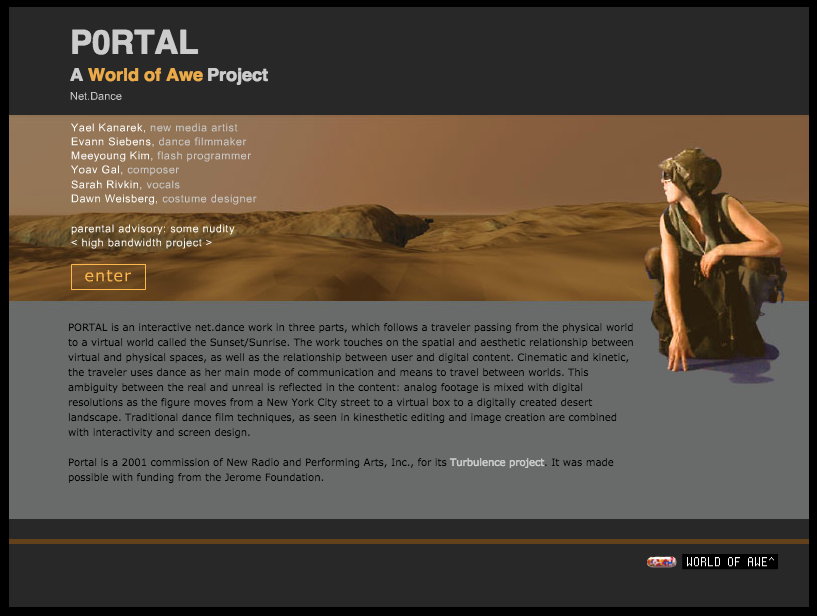
Portal is a net dance created in collaboration with dance filmmaker Evan Siebens and musician Yoav Gal. Flash programming Meeyoung Kim. The work was commissioned by Turbulence.org in 2001 and was featured in a New York Times article in 2004, Art; A Video Game with Awe as Its Quest by Elizabeth Bard.
Jo-Ann Green, Turbulence.org wrote: "We enter the dance via screens within screens, small pixels within large pixels, rendered pixels. This is a net.dance, the spatial and theatrical dimensions of which are very much about surface. We activate the dance square by square. The dance proceeds at the user's pace as we nudge the traveler along. Rather than being transported by the dance, we navigate the dancer's travels for her but there's only so much control we have in this predestined journey, which is hers alone. The traveler is alien to the Manhattan street. While the music's overall impact is hard and discordant—reflecting the city environment—she exists, perhaps, only in our minds as no one appears to notice her, and traffic does not stop for her. She's submerged in a world of make believe, playfully whipping pistols from her imaginary holsters. Each scene within the larger picture is a dance that culminates in a repetitive gesture, machine-like, robotic. We help the traveler negotiate the fence, and launch her into the in-between with a drag and a click.
"There, the traveler is contained and vulnerable but flatness has given way to virtuality. Despite her confinement, we're comforted by her ability to breathe. The music is vocal as if here, though still alone, she no longer feels entirely alien. Still she's caged and unaware of our presence. Her nakedness suggests rebirth: where will she begin? We manipulate her this way and that: as the camera zooms in on her, she becomes progressively fragmented. As she's breaking apart, she suddenly confronts us. The traveler looks right at us and touches our hand—it is this sensory moment that catapults her into the next world.
"The traveler is released into a vast desert where, again, she is alone. Once again the vocal music underlines her aloneness, its multiple voices the same voice. She trudges through the heavy sand, going nowhere. Her mirrored image is reminiscent of the corps de ballet: undifferentiated, regimented, and conformed. She becomes an army of reflections that cannot provide solace. She repeats her solitary dance. Her movements ripple through dunes and sky."
Webpage
http://worldofawe.net/extremebeauty/extremebeauty.html
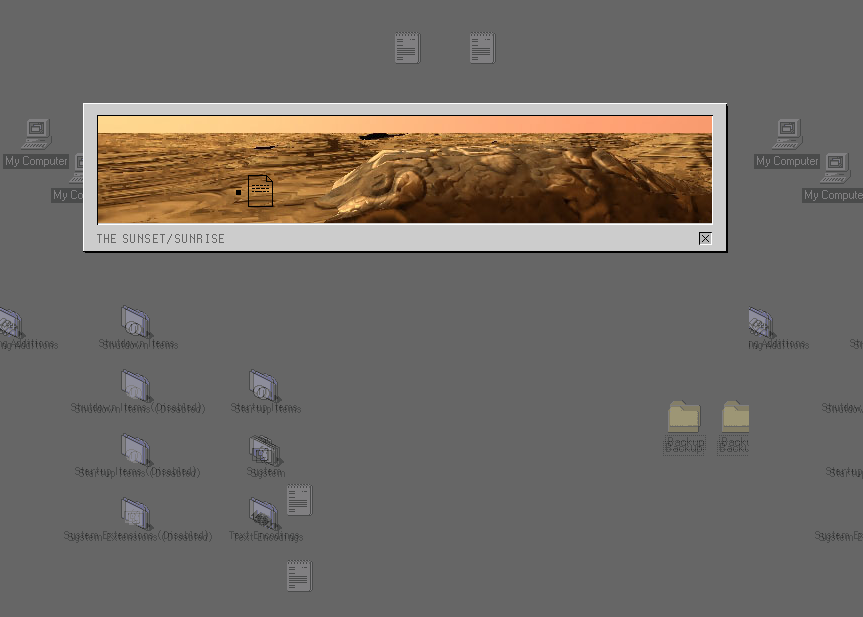
Created for Rhizome.org's Splash Page series in 2001, Extreme Beauty is a short love poem from World of Awe: A Traveler's Journal.
Beloved,
I found the key to extreme beauty,
but not the keyhole.
I tried it in all the holes in my body
none seemed to fit.
Your forever
Your sunset/sunrise forever yours
Yours forever
This short love letter poem appears in many works and media throughout the years.
The piece was collected by Doron Golan for the Computer Fine Arts Collection archived by the Rose Goldsen Archive of New Media Arts at the Cornell University Library.
Website with Flash and audio
http://www.worldofawe.net/hello/
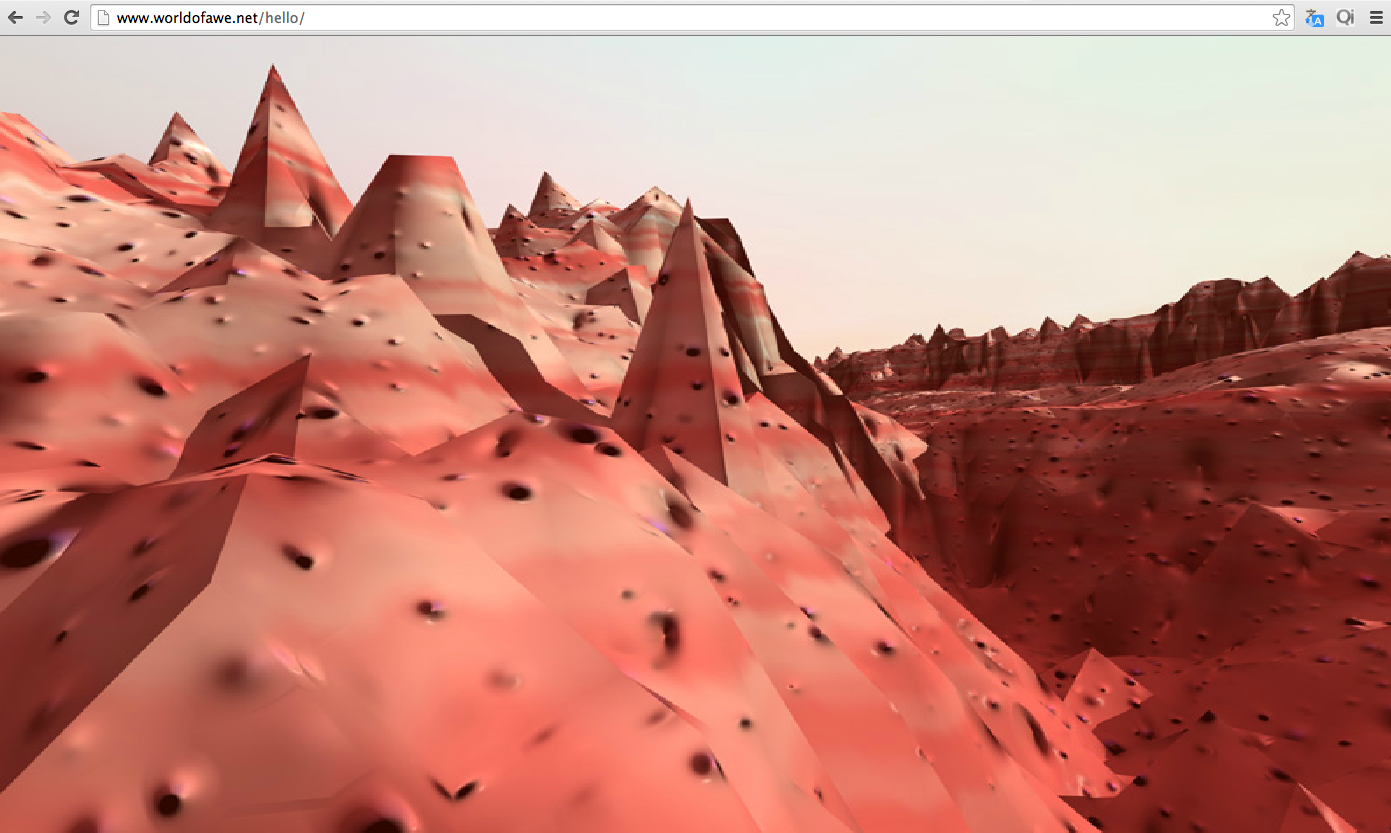
A second splash page comissioned by Rhizome.org, this piece is a single page work that articulates the feeling of yearning.
Website and Flash plugin
http://www.drunkenboat.com/db2/kanarek/kanarek.html
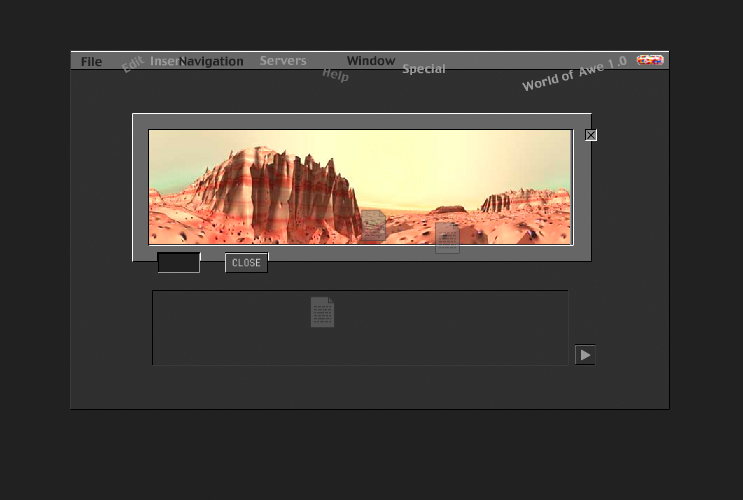
Commissioned for Drunken Boat, an online arts journal edited by Ravi Shankar.
Custom software for PC
Commissioned by the Alternative Museum
Software programmed by Luiz Perez
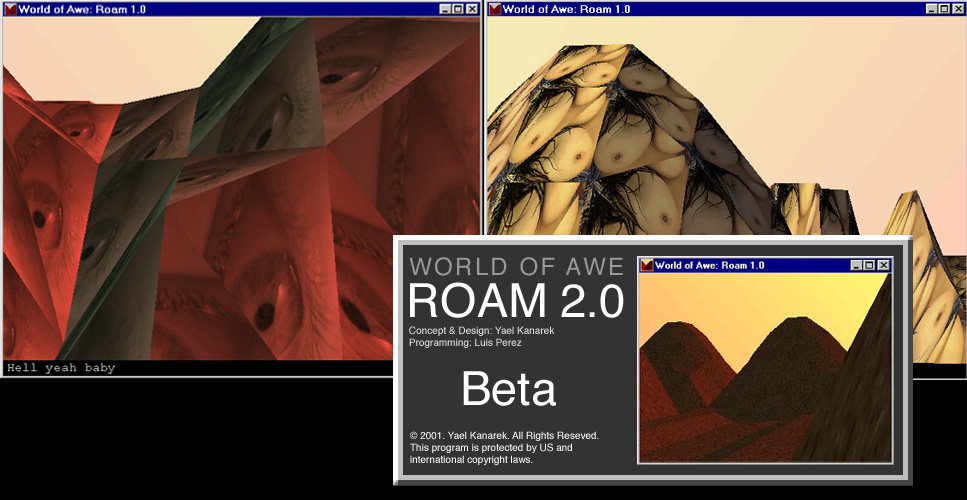
Roam 2.0 was an infinitely generative 3d terrain software. Navigation had two modes: Automatic and user controlled. The intention was to create a 3D game environment for the meditative experience of roaming.
Although the software is now defunct, a series of screenshots of the terrain mapped with different images remain viewable.
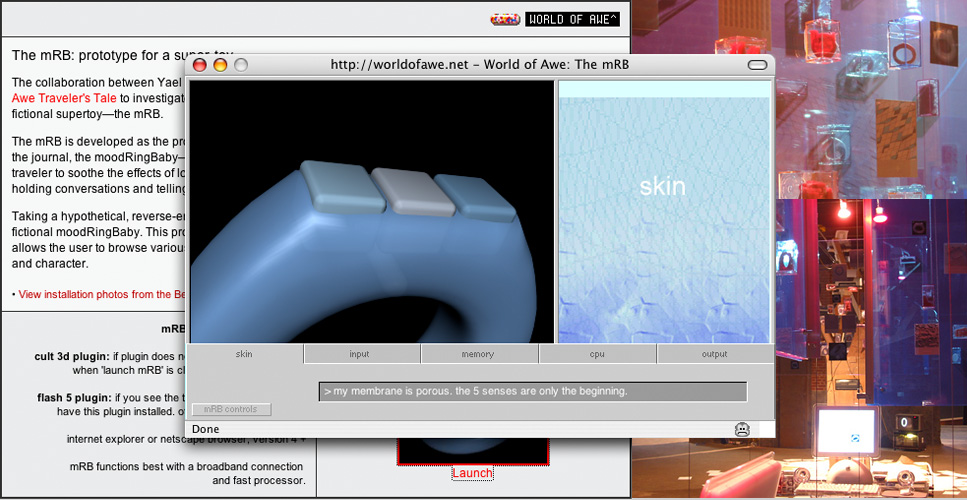
Net art and installation
Collaboration with bnode architects
Created during a residency at Eyebeam, the project speculates on a super-toy called the mRB, modeled after the moodRingBaby mentioned in the World of Awe narrative.
The project was installed at the exhibition Beta Launch at Eyebeam.
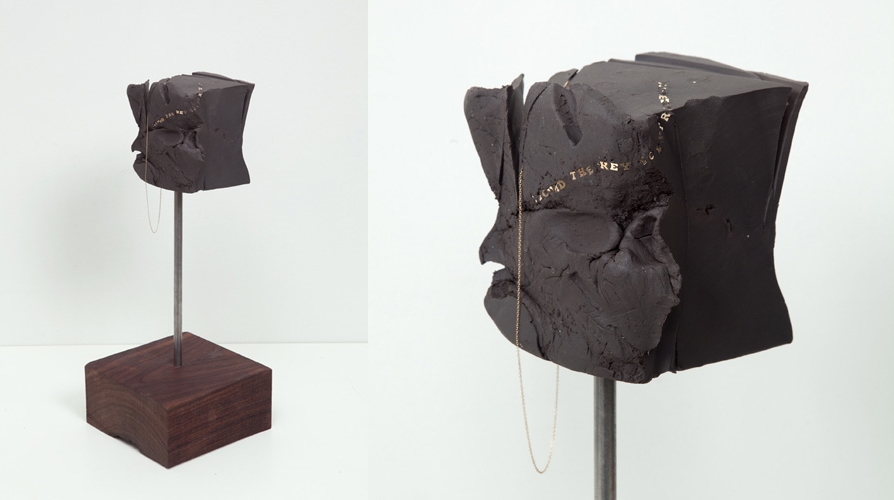
Self-hardening clay, steel, wood, 14k gold chain, lettering
15.75 x 6 x 6 in / 40 x 15.2 x 15.2 cm
Text in 14k gold letters: I found the key to extreme beauty.
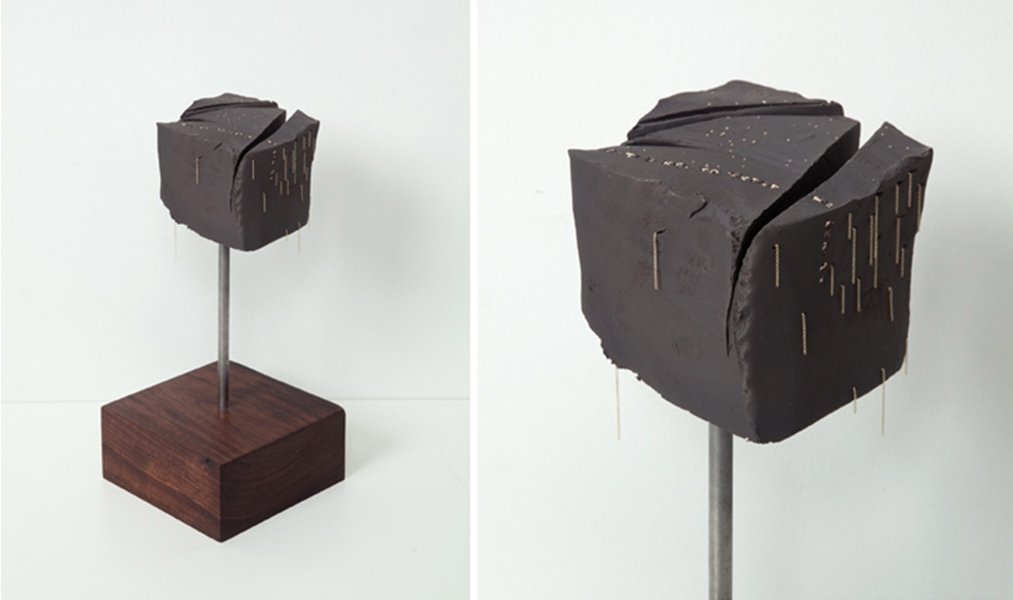
Self-hardening clay, steel, wood, 14k gold chain and lettering
12.25 x 6 x 5.75 in / 31.1 x 15.2 x 14.6 cm
Text: I found the key to extreme beauty.
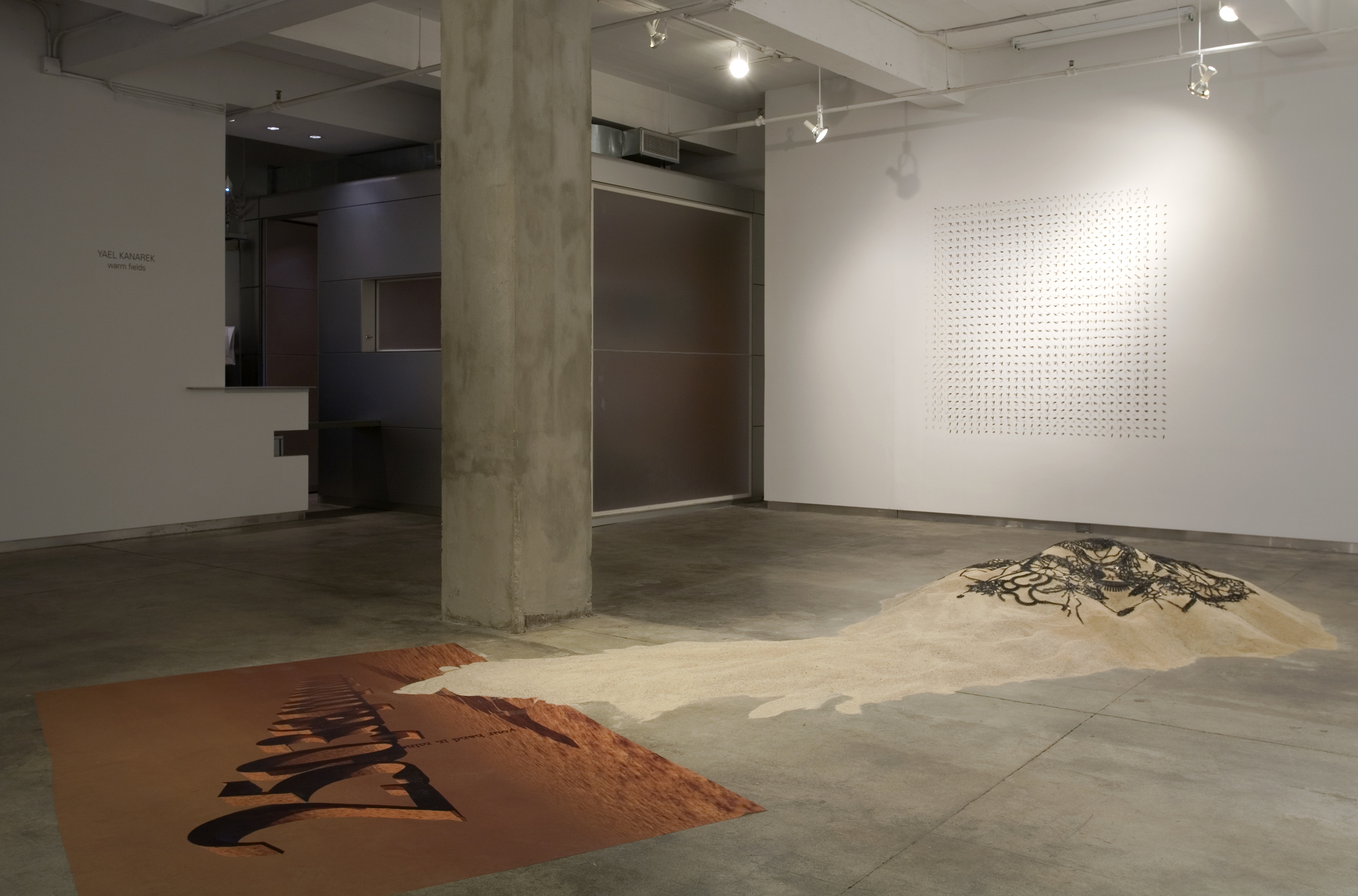
sand, rubber, glue, print on polyester
installation dimensions variable
print: 126" x 118" / 320 x 300 cm
Text: (from Object of Desire)
Love letter 2687/654: Find
Sunset/Sunrise
Precious,
A drop of water in one hand . . . an ocean in the other.
A drop of water is one and an ocean is one.
Many ones within the one. Obvious.
An ocean is a world. A drop of water is a world.
A drop of ocean; such are my treasure crumbs.
There are 250,368,000,000,000,000,000,000 teaspoons of water on planet Earth.
None in Sunset/Sunrise.
Quadrillion, quintillion, sextillion, septillion
000,000,000,000,000,000,000,000,000,000,000
How many cups of tea?
I missed you while near you. I miss you now more.
Your hand in mine.
In the back of my mind harbors the thought:
I don’t know the way back home.
Yours forever
Yours sunset/sunrise forever yours
Yours forever yours
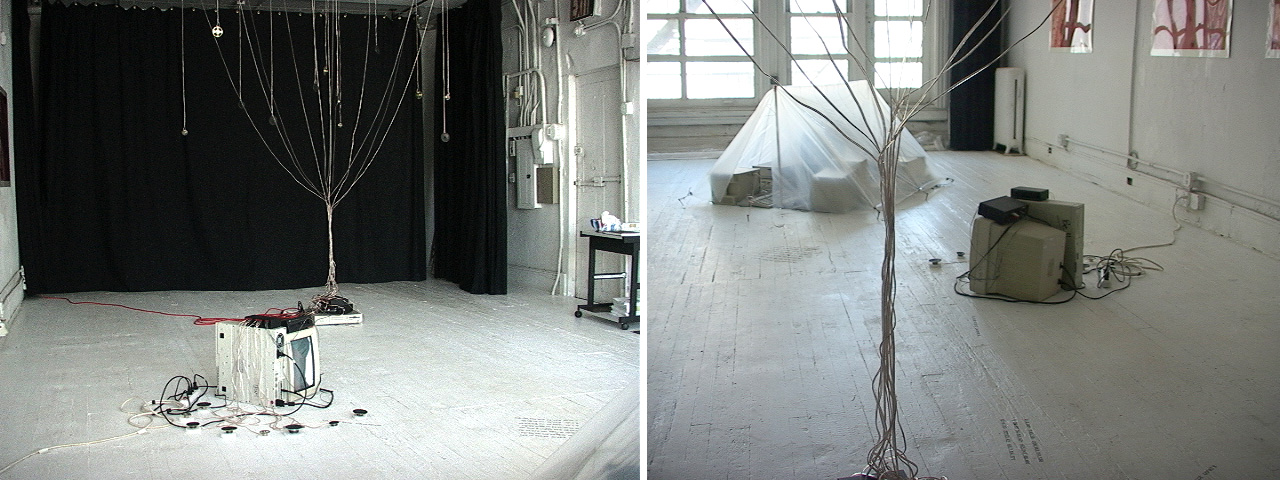
Speakers, computer, cables, wires, soundtrack
Dimensions variable
Audio from Hello, 2002
Installation from the World of Awe solo exhibition at The Moving Image Gallery, New York, directed by curator Michele Thursz, June 7 - June 30, 2001
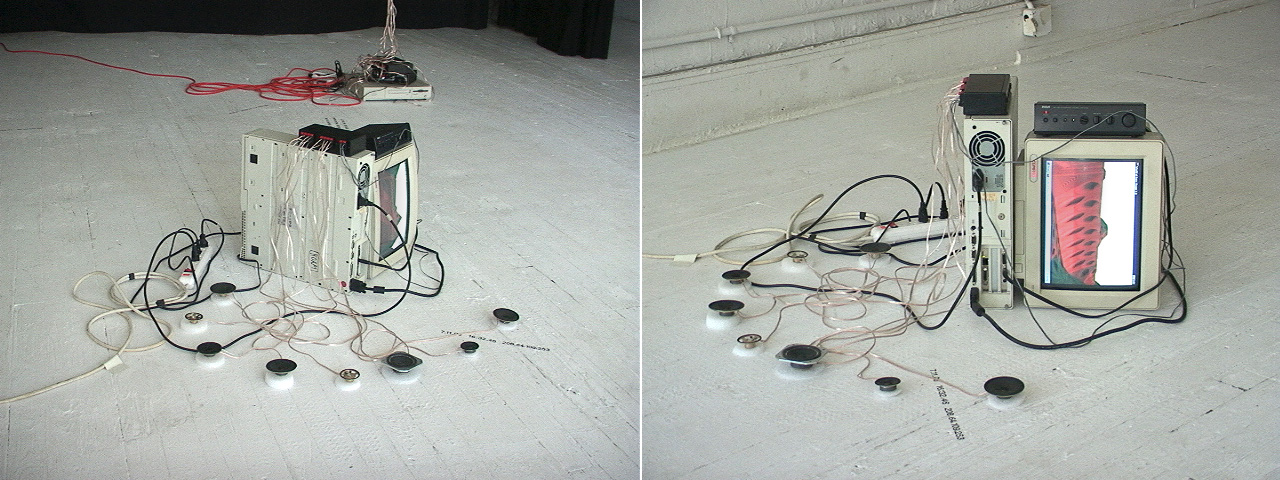
Computer, speakers, custom self-generating landscape software, soundtrack
Dimensions variable
Installation from the World of Awe solo exhibition at The Moving Image Gallery, New York, directed by curator Michele Thursz, June 7 - June 30, 2001
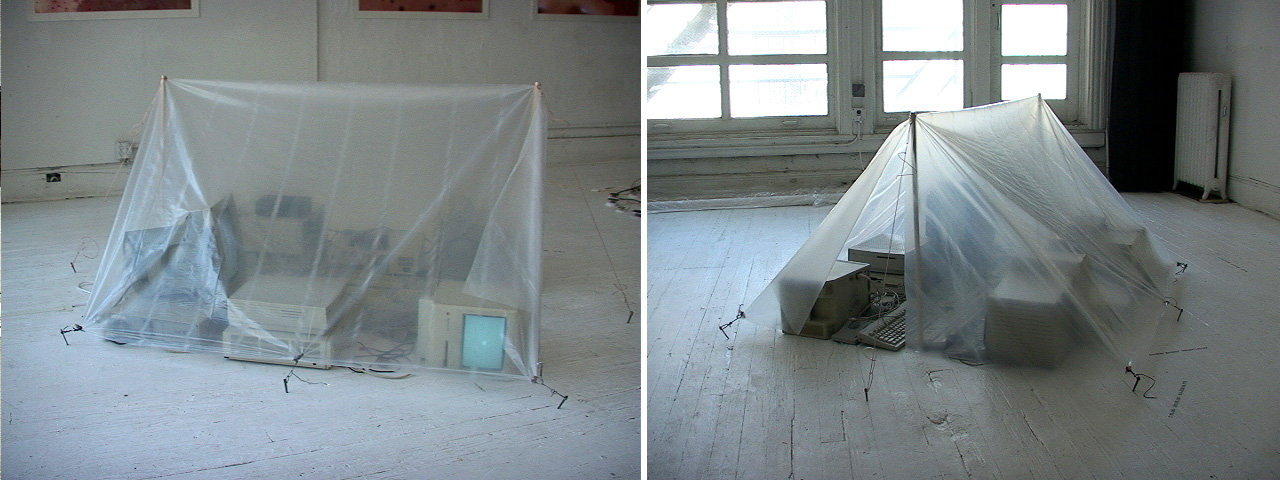
Computers, keyboards, plastic, stick, nails, soundtrack
Audio derived from World of Awe: A Traveler's Journal [section, date]
The installation took place at Moving Image Gallery, NYC from June 7 - June 30, 2001.
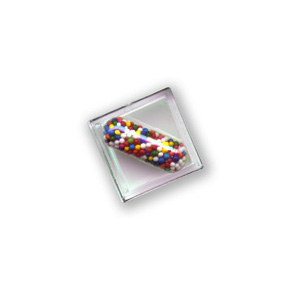
Gelatin capsule, candy sprinkles, acrylic box
1" x 1" x 1" / 2.5 x 2.5 x 2.5 cm
Unlimited edition
Based on "treasure crumbs" from World of Awe: A Traveler's Journal
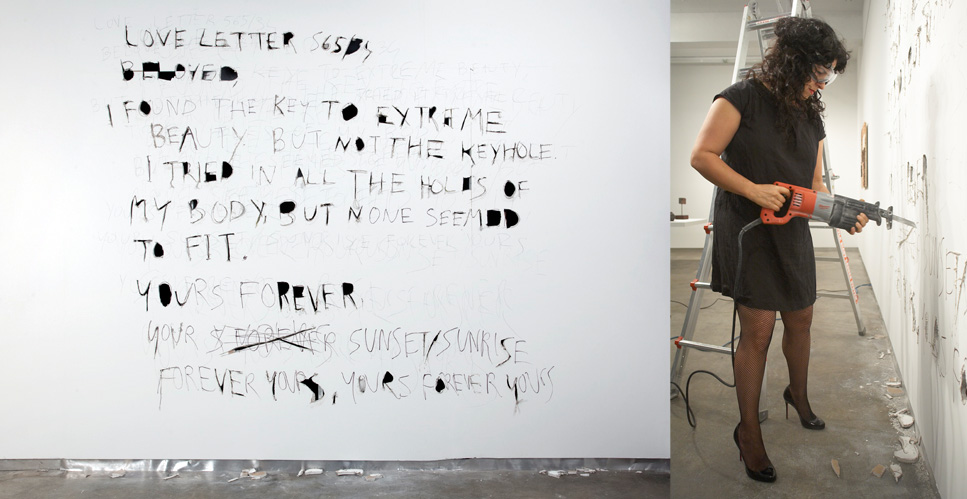
Site-specific installation
Text carved into drywall, pencil, marker
Dimensions vary
The love letter Extreme Beauty is cut out of the gallery wall.
Love Letter 565/35
Sunset/Sunrise
Beloved,
I found the key to extreme beauty,
but not the keyhole.
I tried in all the holes of my body.
None seemed to fit.
Yours forever
Yours Sunset/Sunrise, forever Yours
Yours forever yours
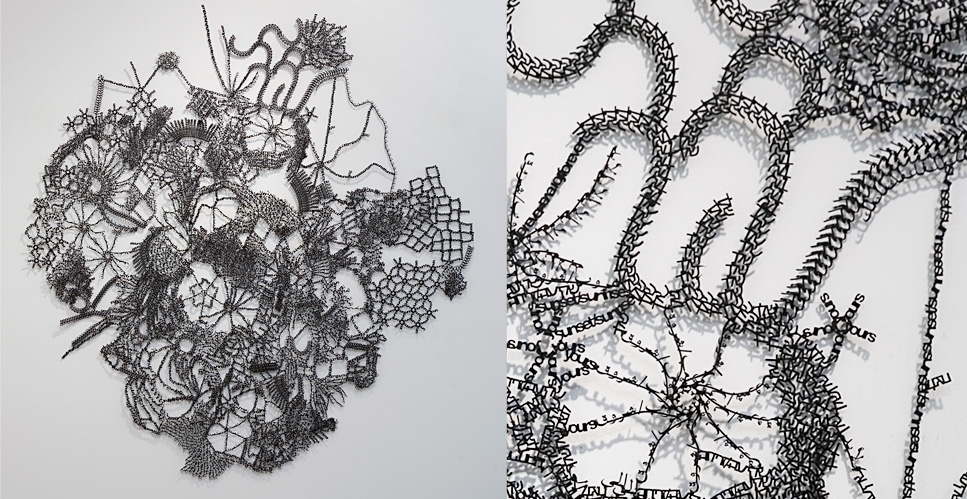
Rubber, pins
66 x 62 in / 167.5 x 157.5 cm
Unavailable
This lacy topography is made of hundreds of rubber words in English, Hebrew, and Arabic, glued one word at a time with industrial automobile glue to form the text that appears as the signature of all the love letters in net art trilogy World of Awe: A Traveler's Journal: "Yours forever, your sunset/sunrise forever yours, your forever yours."
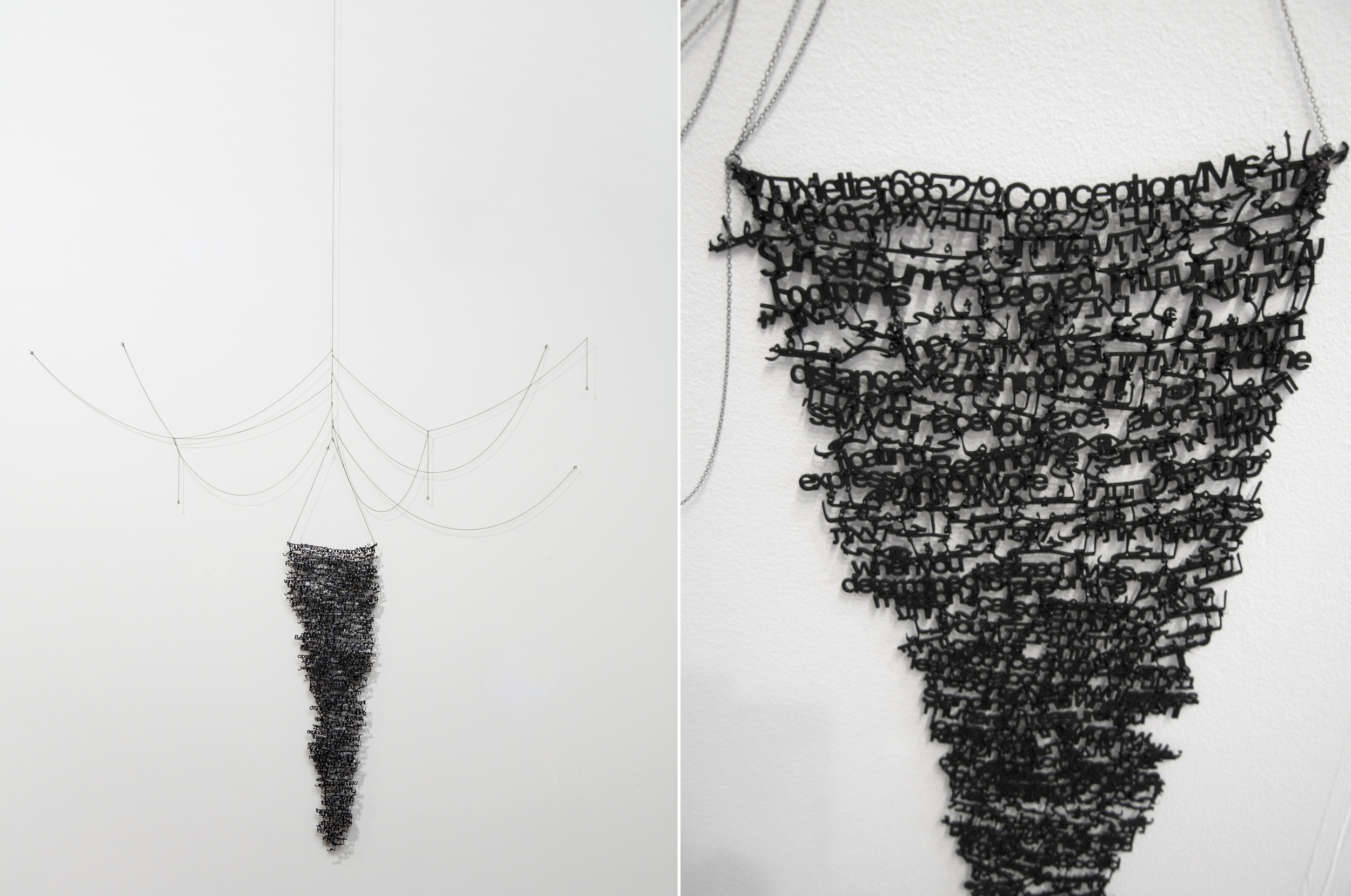
Rubber, silver findings, pins, rubber glue
20 x 10 x 2 in / 51 x 25 x 5 cm
Private collection + 1
The original text in three languages (English, Hebrew, and Arabic) is a love letter, Conception/Mis, from the net artwork Object of Desire.
The text object was built on a friend - around the neck and down the back. The silver chains wrapped around the rib cage and the single vertical line linked the neck with the tip of the text at the tailbone.
+ + +
Love letter 685.2/9: Conception/Mis
Sunset/Sunrise
Beloved,
Footprints left in the dust stretched into the distance. At the vanishing point I saw your face. Your face, alone, floating. Bearing the same expression you wore when you realized I was determined to take on the mission.
I called it a mission, you called it a misconception.
Ever since I learned about the portal I've grown restless. Standing in the kitchen the day before I crossed over: You pressed against the counter, staring in disbelief whenever I muttered treasure. You looked out the window. Cement wall of the next building spilled grey light on the floor. Emotions exploded silently. I edged toward the refrigerator to avoid the debris. You said nothing. I said nothing. Your face faded. I faced forward.
Yours forever
Your sunset/sunrise forever yours
Yours forever yours
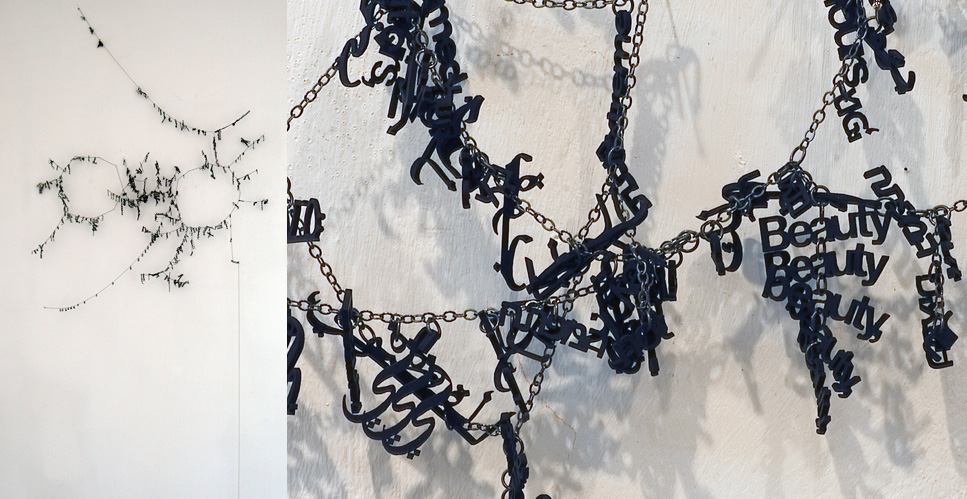
Rubber, silver findings and pins
Approx. 31.5 x 71 in / 80 x 180 cm
Thighlets was constructed around the artist's thighs. The rubber words are cut from an original text, the love letter Extreme Beauty, from the trilogy World of Awe: A Traveler's Journal. The structure is brought back to the wall and hung on pins.
+ + +
Love letter 565/34
Sunset/Sunrise
I found the key to extreme beauty but not the keyhole.
I tried it in all the holes of my body. None seemed to fit.
yours forever
your sunset/sunrise forever yours
yours forever yours
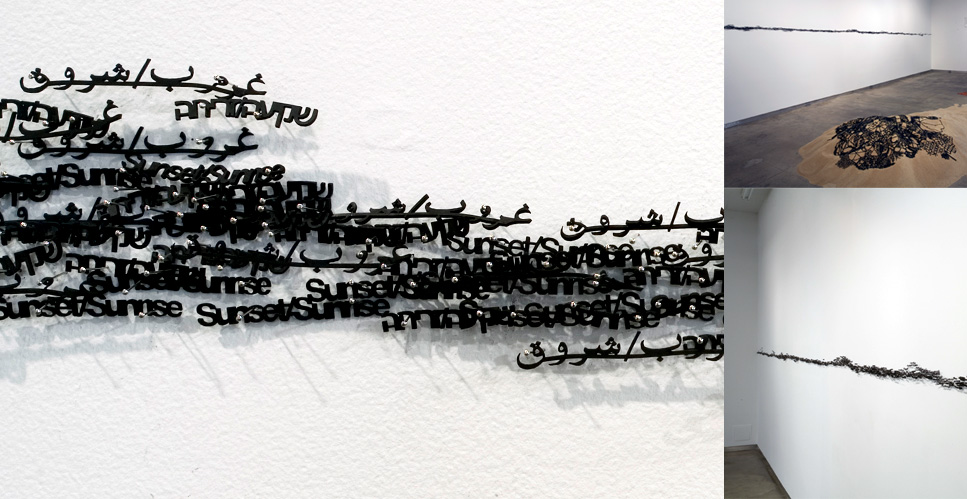
Rubber and pins
Approx. 384 in / 1000 cm
Thousands of rubber words are pinned to the wall. The word combination "Sunset/Sunrise" in English, Hebrew, and Arabic forms a ragged horizon.
In English, sunset and sunrise point to a human-centric experience, as the sun neither rise nor sinks. In Arabic, the words are derived from the words east (ghoroob) and west (shorooq), pointing to a geographically-coordinated language. In Hebrew the words translate into shine (zrikha - root for "east'") and submerge (shki'a).
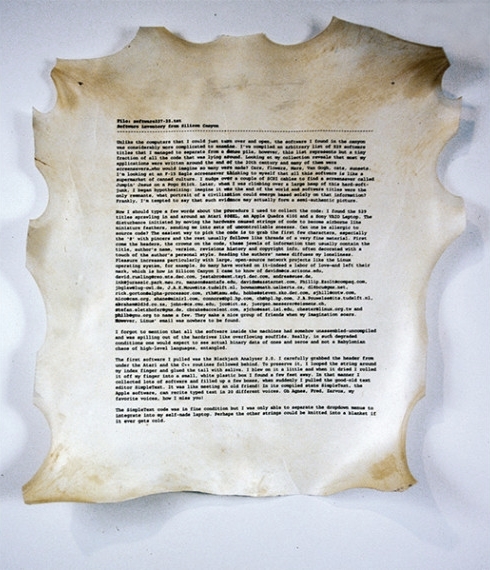
Silkscreen on parchment
Diary entry from World of Awe: A Traveler's Journal silk-screened on parchment
Font: Courier
Text:
File: software327-25.txt Software inventory from Silicon Canyon
--------------------------------------------------------------
Unlike the computers that I could just turn over and open, the software I found in the canyon was considerably more complicated to examine. I've compiled an arbitrary list of 529software titles that I managed to separate from a dense pile, however, this list represents but a tiny fraction of all the code that was lying around. Looking at my collection reveals that most of the applications were written around the end of the 20th century and many of them were screensavers … who would imagine so many were made?Cars, flowers, Mars,Van Gogh, cats, sunsets. I'm looking at an F-15 Eagle screensaver thinking to myself that all this software is like a supermarket of canned culture. I nudge over a couple of SCSI cables to find a screensaver called Jumpin' Jesus on a Pogo Stick.Later, when I was climbing over a large heap of this hard-soft-junk, I began hypothesizing: imagine it was the end of the world and software titles were the only remnants, what portrait of a civilization could emerge based solely on that information? Frankly, I'm tempted to say that such evidence may actually form a semi-authentic picture.
Now I should type a few words about the procedure I used to collect the code: I found the 529 titles sprawling in and around an Atari800XL, an Apple Quadra 6100 and a Sony VAIO Laptop.The disturbance initiated by moving the hardware caused strings of code to become airborne like miniature feathers, sending me into sets of uncontrollable sneezes. Can one be allergic to source code? The easiest way to pick the code is to grab the first few characters, especially the '#' with pincers and the rest usually follows like threads of a very fine material. First come the headers, the crowns on the code, these jewels of information that usually contain the title,author's name, version, revisions history and copyright info, often decorated with a touch of the author's personal style. Reading the authors' names diffuses my loneliness. Pleasure increases particularly with large, open-source network projects like the Linux operating system, for example. So many have worked on it—indeed a labor of love—and left their mark, which is how in Silicon Canyon I came to know of davidm@cs.arizona.edu, david.rusling@reo.mts.dec.com, jestabro@amt.tay1.dec.com, andrea@suse.de, ink@jurassic.park.msu.ru, manson@santafe.edu, davidm@azstarnet.com, Phillip.Ezolt@compaq.com, jbglaw@lug-owl.de, J.A.K.Mouw@its.tudelft.nl, bowman@math.ualberta.ca, dl8bcu@gmx.net, rick.gorton@alpha-processor.com, rth@tamu.edu, hobbs@steven.zko.dec.com, sjhill@cotw.com, nico@cam.org, shane@minirl.com, connors@hpl.hp.com, ch@hpl.hp.com, J.A.Pouwelse@its.tudelft.nl, abraham@2d3d.co.za, john+@cs.cmu.edu, jco@ict.es, juergen.messerer@siemens.ch, stefan.eletzhofer@gmx.de, cbrake@accelent.com, sjcho@east.isi.edu, chester@linux.org.tw andphilb@gnu.org to name a few. They make a nice group of friends when my imagination soars. However, Linus' email was nowhere to be found.
I forgot to mention that all the software inside the machines had some how unassembled-uncompiled and was spilling out of the hard drives like overflowing soufflés. Really, in such degraded conditions one would expect to see actual binary data of ones and zeros and not a Babylonian chaos of high-level languages, entangled.
The first software I pulled was the Blackjack Analyzer 2.0. I carefully grabbed the header from under the Atari and the C++ routines followed behind. To preserve it, I looped the string around my index finger and glued the tail with saliva. I blew on it a little and when it dried I rolled it off my finger into a small, white plastic box I found a few feet away. In that manner I collected lots of software and filled up a few boxes, when suddenly I pulled thegood-old text editorSimpleText. It was like meeting an old friend! Inits compiled stateSimpleText, the Apple software, can recite typed text in 20 different voices. Oh Agnes, Fred, Zarvox, my favorite voices, how I miss you!
The SimpleText code was in fine condition but I was only able to separate the dropdown menus to integrate into my selfmade laptop. Perhaps the other strings could be knitted into a blanket if it ever gets cold.
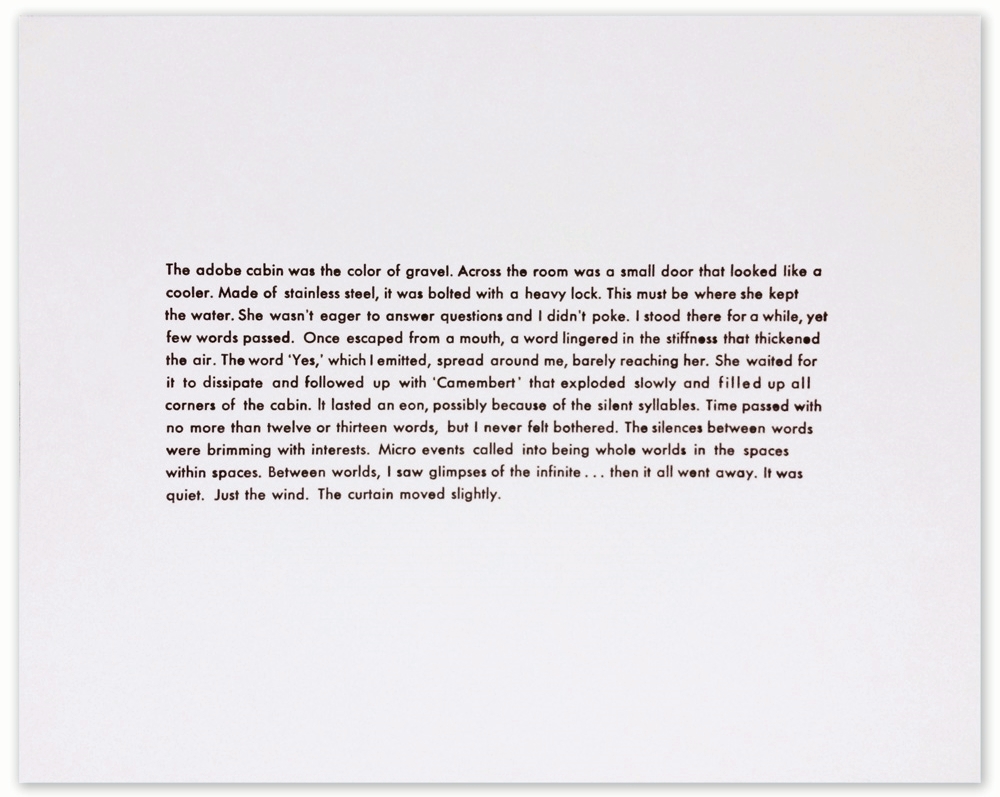
Handset letterpress print, purple ink on paper
11.25 x 14.25" / 28.6 x 36.2 cm
1/13 2AP
Letterpress prints of a paragraph from World of Awe: A Traveler's Journal, handset and printed during an artist's visit to the Goldsmith Press & Rare Type Collection at Austin Peay State University.
Text:
Travelog 159-78: Oldy, paragraph 7
The adobe cabin was the color of gravel. Across the room was a small door that looked like a cooler. Made of stainless steel, it was bolted with a heavy lock. This must be where she kept the water. She wasn’t eager to answer questions and I didn’t poke. I stood there for a while, yet few words passed. Once escaped from a mouth, a word lingered in the stiffness that thickened the air. The word 'Yes,' which I emitted, spread around me, barely reaching her. She waited for it to dissipate and followed up with 'Camembert' that exploded slowly and filled up all corners of the cabin. It lasted an eon, possibly because of the silent syllables. Time passed with no more then twelve or thirteen words, but I never felt bothered. The silences between words were brimming with interests. Micro events called into being whole worlds in the spaces within spaces. Between worlds, I saw glimpses of the infinite... then it all went away. It was quiet. Just the wind. The curtain moved slightly.
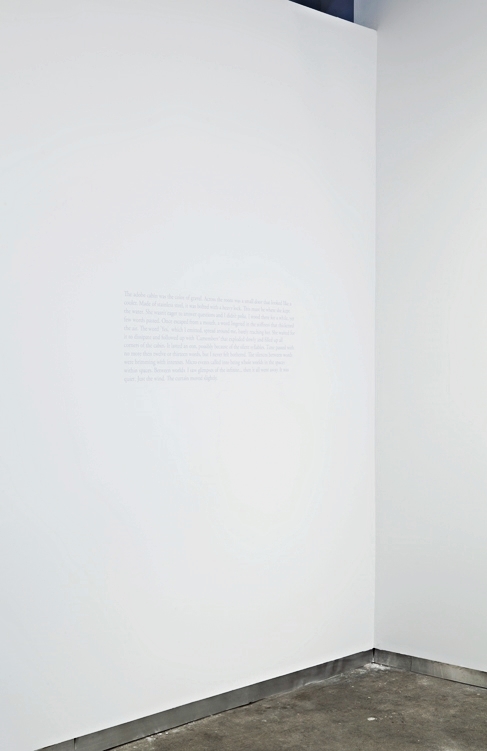
Vinyl wall text
Dimensions variable
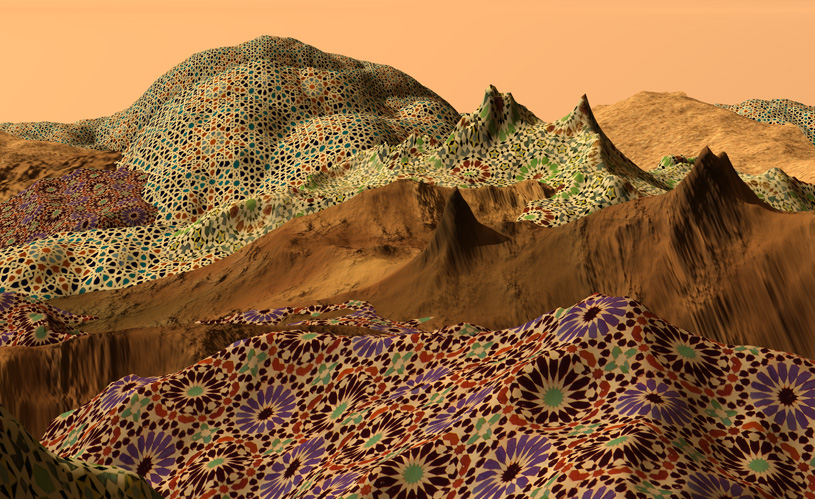
Lambda print
44.5 x 70" / 113 x 178 cm
Edition of 3
This landscape is animated in the scene Copy, from Object of Desire:
Travelog 720.5/2: Copy
Sunset/Sunrise
Tangerine sky. A ray illuminates my neck. It stays there. Time suspended. I key my notes into the laptop. Letters dispel the handwriting and elude my temper, paper, and the ballpoint pen.
The laptop welcomes the letters and assigns them numbers. Electric-alive, my idiom flickers on the screen. Delighted in the power of computation: Copy, paste, find, replace. CTRL+Z. Power. Speed. I penetrate.
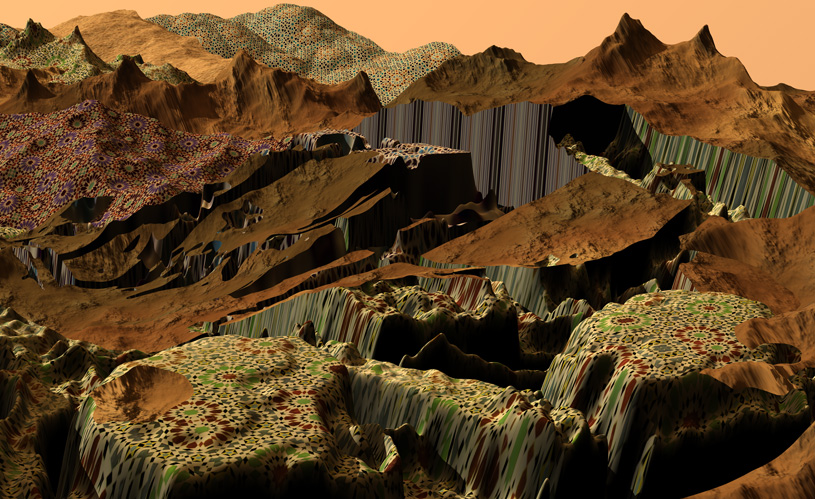
Lambda print
44.5 x 70 in / 113 x 178 cm
Edition of 3
This landscape is "torn" by mapping a journalistic photo of a political murder that circulated in the news several years ago. Its source is the Israeli-Palestinian conflict.
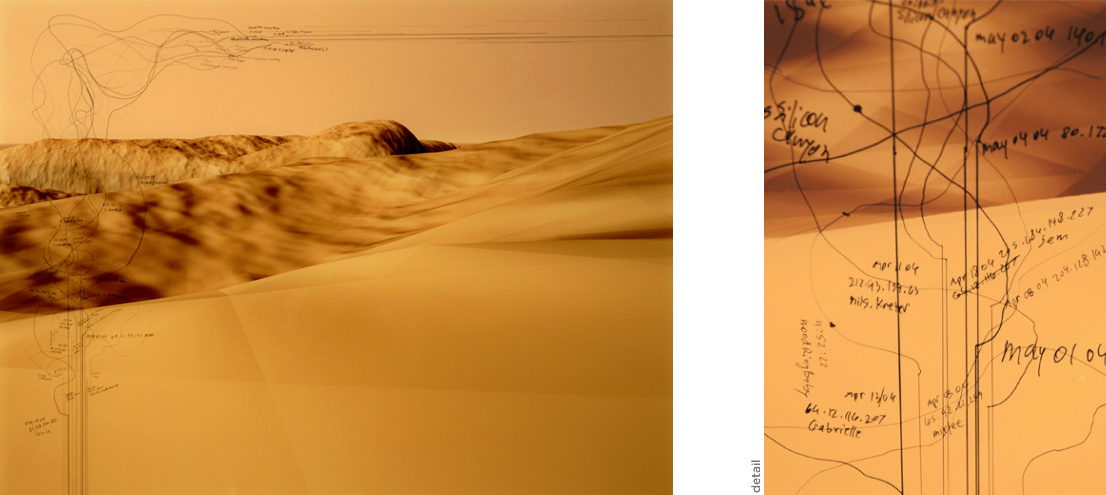
Ink drawing on Lambda print plexi-mounted
44 x 34 in / 112 x 86 cm
Unique
About traffic data: As visitors navigate the net artwork World of Awe: A Traveler's Journal they leave tracking data like footprints. That data includes IP address, pages visited and time of entry. The data is then filtered and hand-drawn, spontaneously, on the 3D desert landscape print.
Here the traffic data was filtered to identify the first and last diary entry accessed by several visitors. The difference in timestamps indicate the time they spent in the Traveler's Journal.
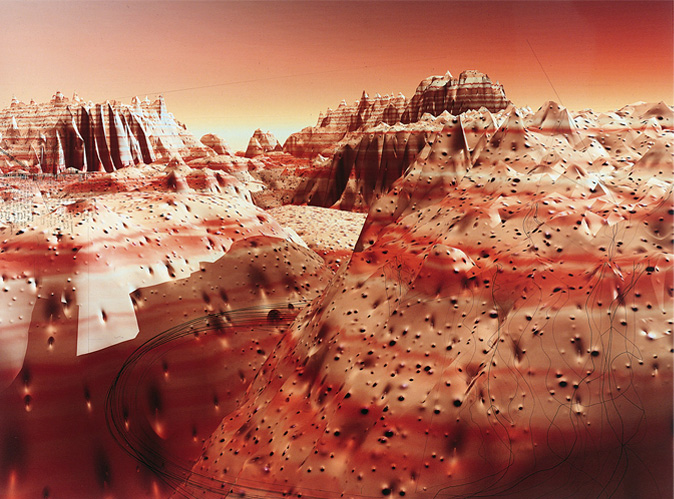
Ink drawing on Lambda print
30 x 40 in / 76 x 102 cm
Unique
As visitors navigate World of Awe: A Traveler's Journal, they leave behind tracking data including IP address, pages visited, and time of download requests. These traces are then filtered and spontaneously hand-drawn on the 3D desert landscape print.
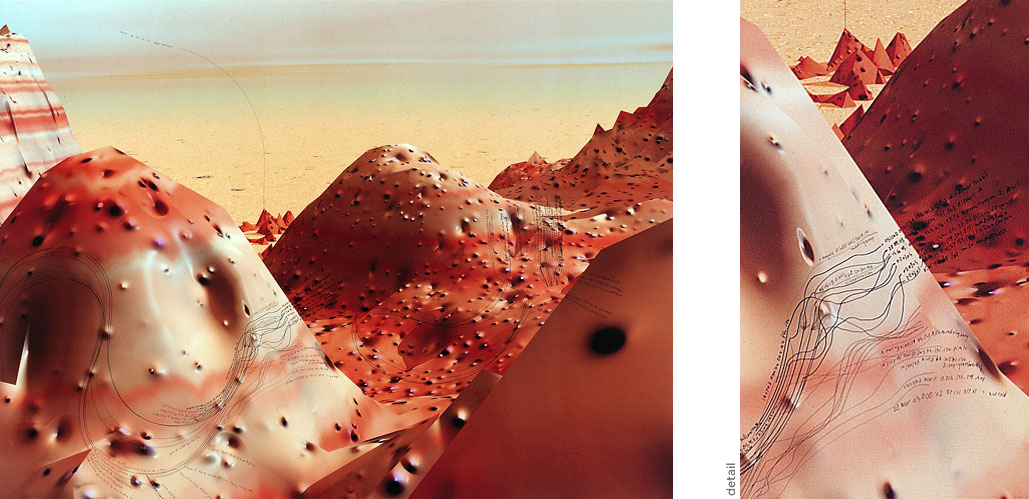
Ink drawing on Lambda print
30 x 40 in / 76 x 102 cm
Unique
As visitors navigate World of Awe: A Traveler's Journal, they leave behind tracking data including IP address, pages visited, and time of download requests. These traces are then filtered and spontaneously hand-drawn on the 3D desert landscape print.
The data in this piece represents the first 90 seconds of the day: 00:00:00 – 00:01:30.
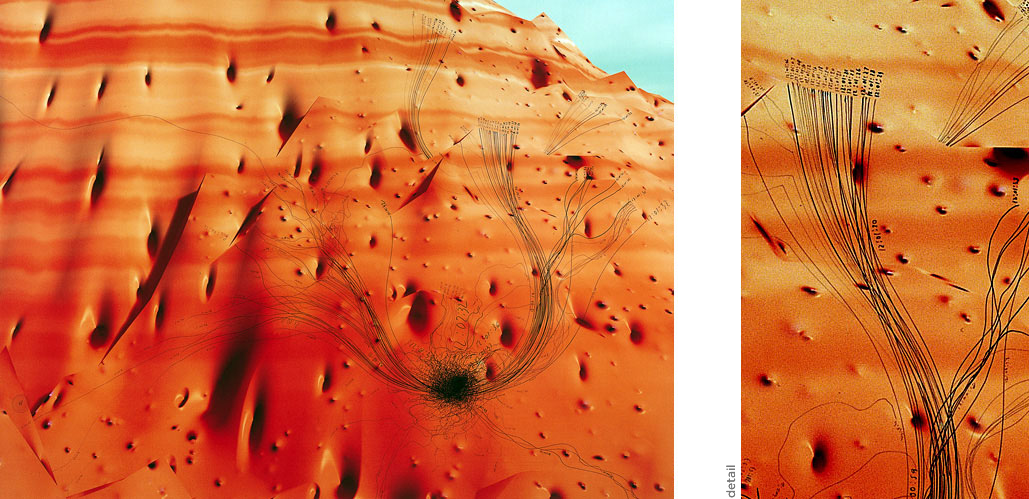
Ink drawing on Lambda print
30 x 40 in / 76 x 102 cm
Unique
As visitors navigate World of Awe: A Traveler's Journal, they leave behind tracking data including IP address, pages visited, and time of download requests. These traces are then filtered and spontaneously hand-drawn on the 3D desert landscape print.
This data represents a swarm of timestamps that hit the server over a period of several months.
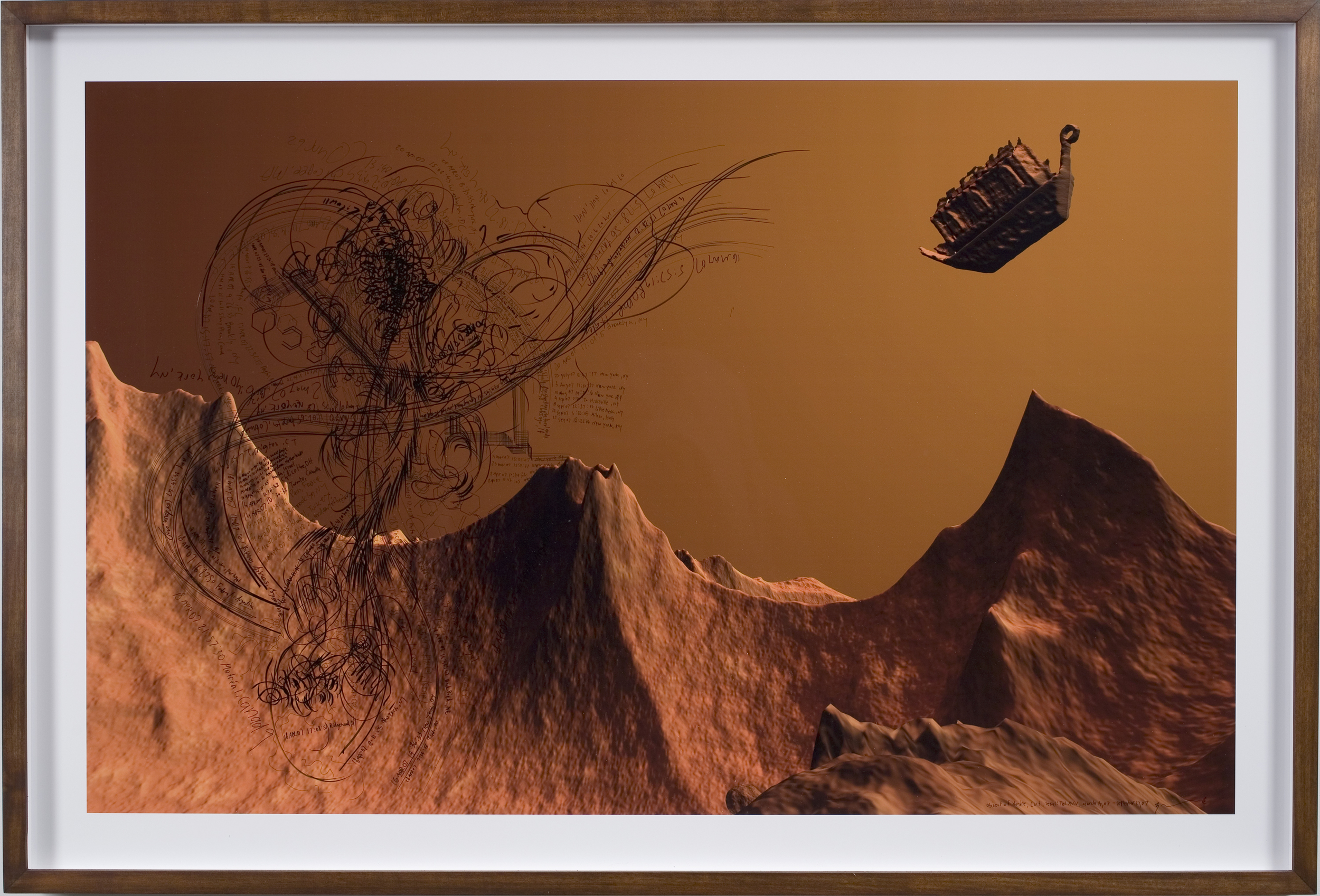
Ink drawing on Lambda print
29 x 42.5 in / 74 x 108 cm
Unique
A rendering from the scene Undo in Object of Desire, using an image from the 1895 Montgomery Ward & Co. Catalogue and Buyer's Guide as the basis for the ark model. The hand-drawing interprets traffic data left by those who visited the Undo webpages, then hosted on a server in Tel Aviv by the Israeli Center for Digital Art's ArtLab.
This work was included in the solo exhibition Object of Desire exhibition at the Jewish Museum's Media Center in New York.
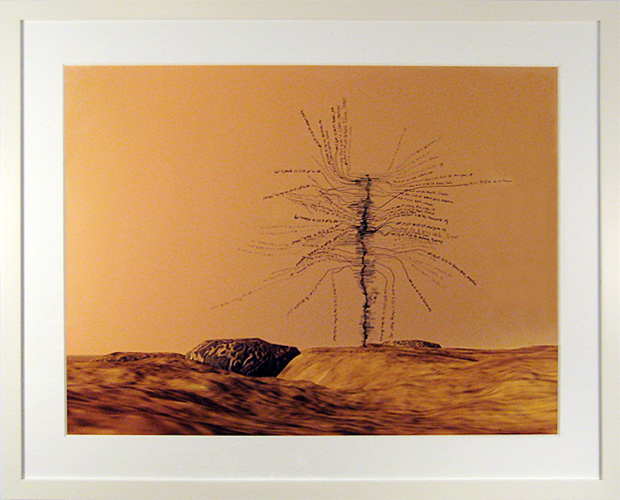
Ink drawing on Lambda print
20 x 15 in / 51 x 38 cm
Unique
Private collection
A rendering from the scene Crumbs in Object of Desire. The ink drawing interprets traffic data left by those who visited the Crumbs webpages, then hosted on a server in Ramallah, Palestine.
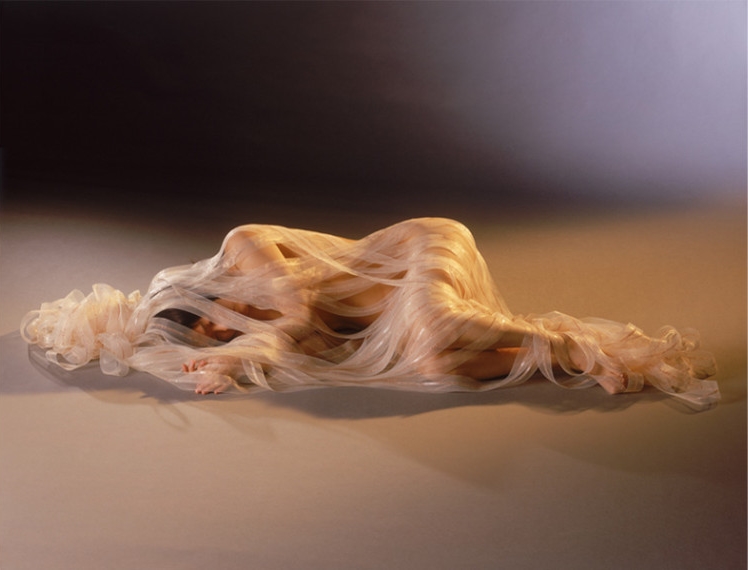
Digital C-Print
23 x 30 1/2 in / 58.6 x 77.2 cm
60 3/4 x 66 in / 154.2 x 167.6 cm
Edition of 6, 1 AP
"Cycles" is a photographic series of performed actions, as written in computer code (Linux Kernel). This machine language, a narrative of instructions based on English, is then transferred to organza ribbon. A single character, the User, performs machine and human functions in a sterile, functional environment warmed by low orange light reminiscent of a sunset or sunrise.
The final resting point for the code is in two sculptures: SPIN_LOCK and Heart in Heart.
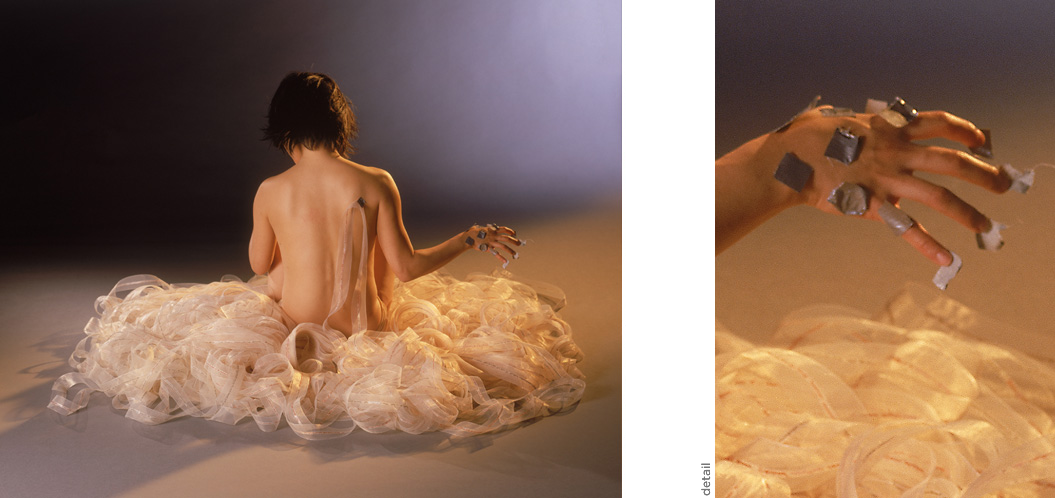
Digital C-Print
23 x 30 1/2 in / 58.6 x 77.2 cm
60 3/4 x 66 in / 154.2 x 167.6 cm
Edition of 6, 1 AP
"Cycles" is a photographic series of performed actions, as written in computer code (Linux Kernel). This machine language, a narrative of instructions based on English, is then transferred to organza ribbon. A single character, the User, performs machine and human functions in a sterile, functional environment warmed by low orange light reminiscent of a sunset or sunrise.
The final resting point for the code is in two sculptures: SPIN_LOCK and Heart in Heart.
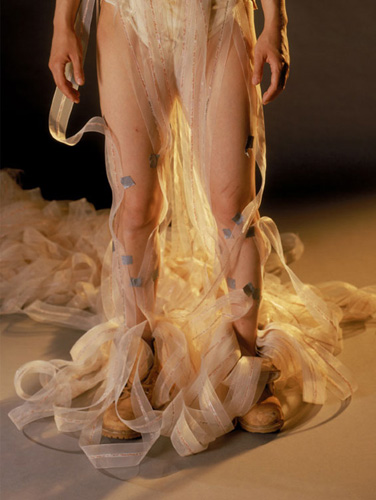
Digital C-Print
24 5/8 x 18 1/2 in / 62.5 x 47 cm
66 x 51 in / 167.6 x 129.5 cm
Edition of 6, 1 AP
"Cycles" is a photographic series of performed actions, as written in computer code (Linux Kernel). This machine language, a narrative of instructions based on English, is then transferred to organza ribbon. A single character, the User, performs machine and human functions in a sterile, functional environment warmed by low orange light reminiscent of a sunset or sunrise.
The final resting point for the code is in two sculptures: SPIN_LOCK and Heart in Heart.
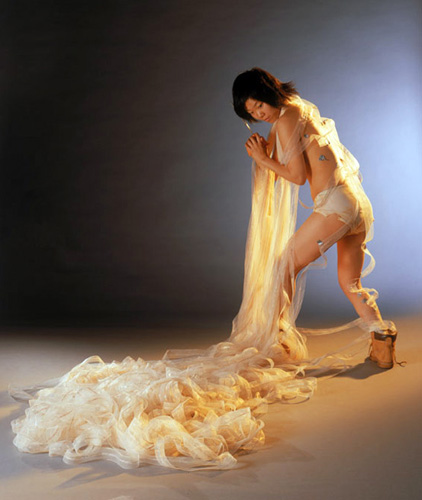
Digital C-print
28 x 21.5 in / 71.1 x 54.6 cm
66 x 51.75 in / 167.6 x 131.4 cm
Edition of 6, 1 AP
"Cycles" is a photographic series of performed actions, as written in computer code (Linux Kernel). This machine language, a narrative of instructions based on English, is then transferred to organza ribbon. A single character, the User, performs machine and human functions in a sterile, functional environment warmed by low orange light reminiscent of a sunset or sunrise.
The final resting point for the code is in two sculptures: SPIN_LOCK and Heart in Heart.
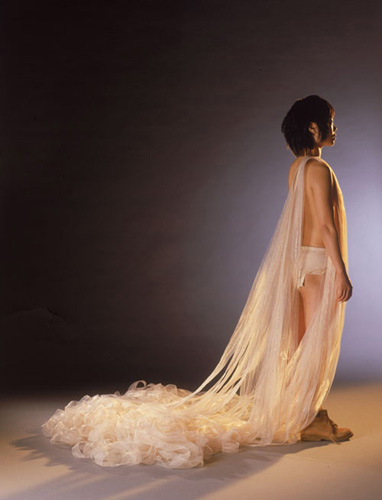
Digital C-Print
28 x 21 1/2 / 71.1 x 54.6 cm
66 x 51 3/4 / 167.6 x 131.4 cm
Edition of 6, 1 AP
"Cycles" is a photographic series of performed actions, as written in computer code (Linux Kernel). This machine language, a narrative of instructions based on English, is then transferred to organza ribbon. A single character, the User, performs machine and human functions in a sterile, functional environment warmed by low orange light reminiscent of a sunset or sunrise.
The final resting point for the code is in two sculptures: SPIN_LOCK and Heart in Heart.
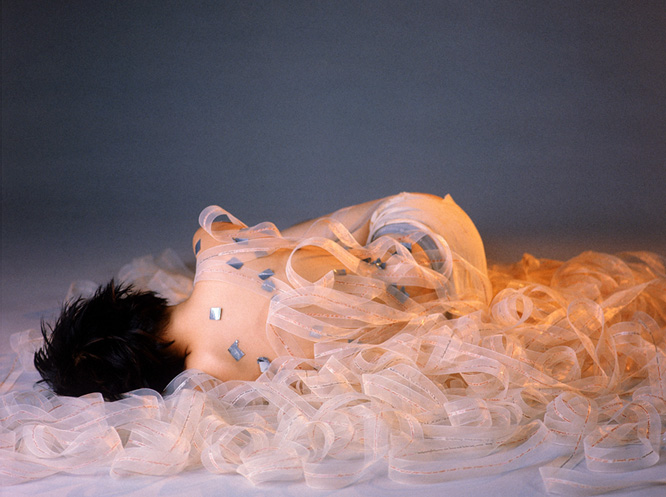
Digital C-print
13.5 x 18.5 in / 34 x 46.7 cm
44 x 34 in / 112 x 86 cm
Edition of 6, 1 AP
"Cycles" is a photographic series of performed actions, as written in computer code (Linux Kernel). This machine language, a narrative of instructions based on English, is then transferred to organza ribbon. A single character, the User, performs machine and human functions in a sterile, functional environment warmed by low orange light reminiscent of a sunset or sunrise.
The final resting point for the code is in two sculptures: SPIN_LOCK and Heart in Heart.
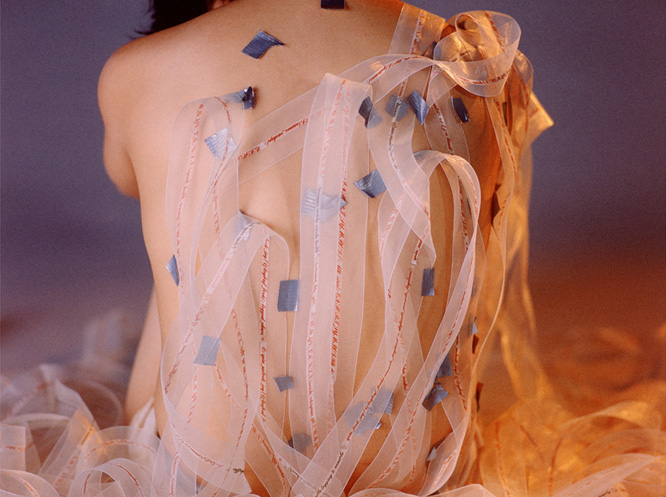
Digital C-Print
44 x 34 in / 112 x 86 cm
Edition of 6, 1 AP
"Cycles" is a photographic series of performed actions, as written in computer code (Linux Kernel). This machine language, a narrative of instructions based on English, is then transferred to organza ribbon. A single character, the User, performs machine and human functions in a sterile, functional environment warmed by low orange light reminiscent of a sunset or sunrise.
The final resting point for the code is in two sculptures: SPIN_LOCK and Heart in Heart.
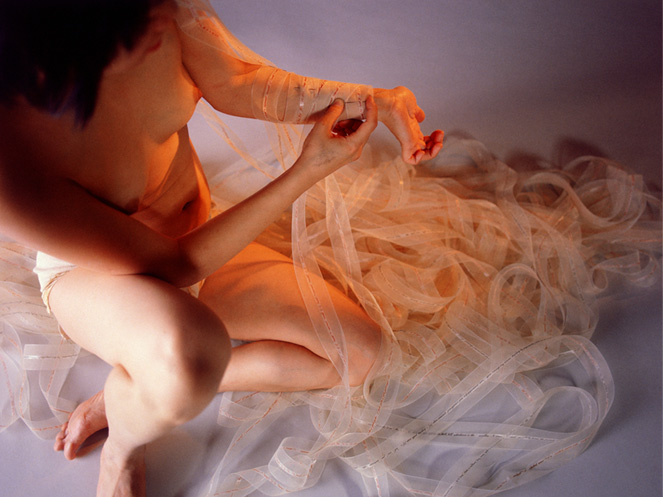
Digital C-Print
44 x 34 in / 112 x 86 cm
Edition of 6, 1 AP
"Cycles" is a photographic series of performed actions, as written in computer code (Linux Kernel). This machine language, a narrative of instructions based on English, is then transferred to organza ribbon. A single character, the User, performs machine and human functions in a sterile, functional environment warmed by low orange light reminiscent of a sunset or sunrise.
The final resting point for the code is in two sculptures: SPIN_LOCK and Heart in Heart.
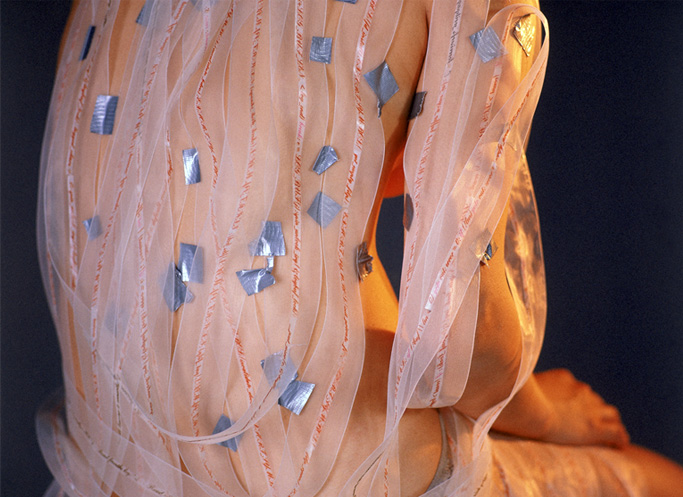
Digital C-print
13.5 x 18.5 in / 34 x 46.7 cm
44 x 34 in / 112 x 86 cm
Edition of 6, 1 AP
"Cycles" is a photographic series of performed actions, as written in computer code (Linux Kernel). This machine language, a narrative of instructions based on English, is then transferred to organza ribbon. A single character, the User, performs machine and human functions in a sterile, functional environment warmed by low orange light reminiscent of a sunset or sunrise.
The final resting point for the code is in two sculptures: SPIN_LOCK and Heart in Heart.
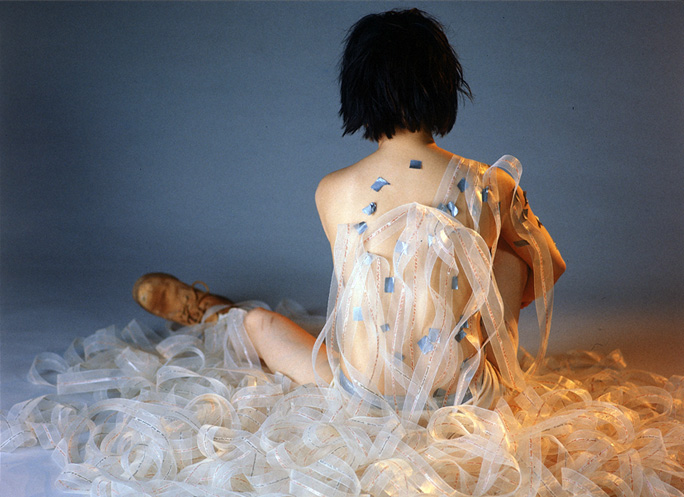
Digital C-print
13.5 x 18.5 in / 34 x 46.7 cm
44 x 34 in / 112 x 86 cm
Edition of 6, 1 AP
"Cycles" is a photographic series of performed actions, as written in computer code (Linux Kernel). This machine language, a narrative of instructions based on English, is then transferred to organza ribbon. A single character, the User, performs machine and human functions in a sterile, functional environment warmed by low orange light reminiscent of a sunset or sunrise.
The final resting point for the code is in two sculptures: SPIN_LOCK and Heart in Heart.
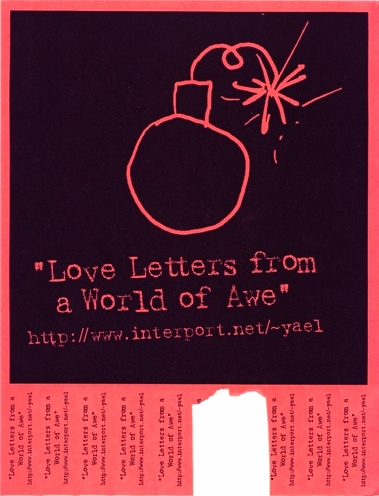
The first flier in the East Village cafes to include a URL to a net art work, possibly the first flier to include a URL altogether.
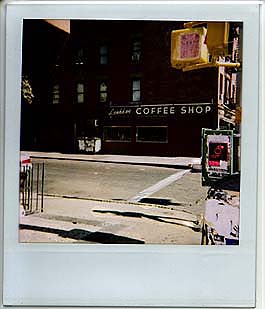
Polaroid
Unique
This polaroid was taken on the corner of 7th Street and Avenue A. The establishment across the street is long gone. The polaroid was scanned and introduced into the net art piece it promotes to create a feedback loop between the physical and virtual spaces.
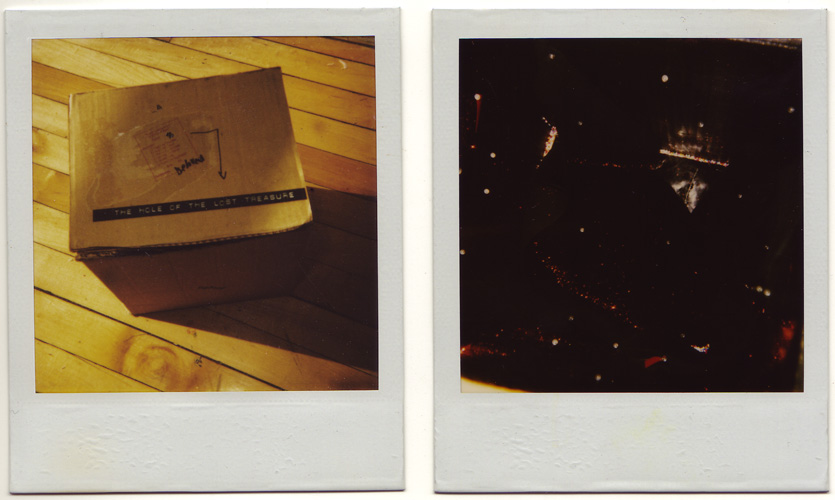
Cardboard box, black velvet, small things
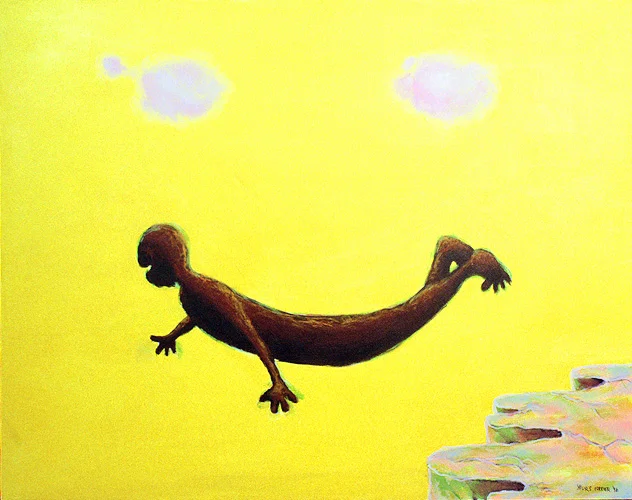
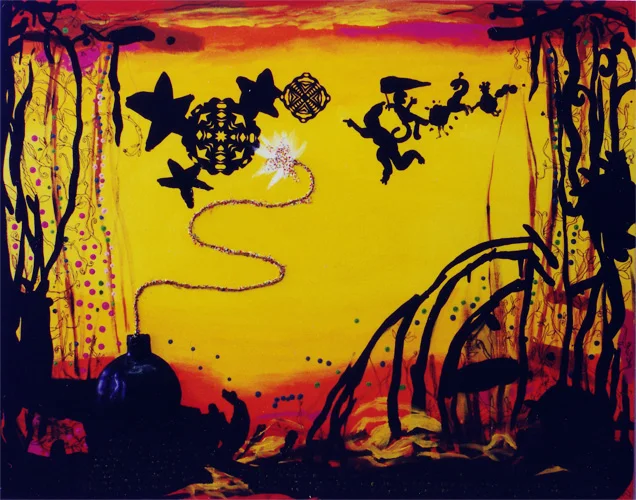
These two polaroids show interior and exterior shots of the sculpture The Hole of the Lost Treasure.
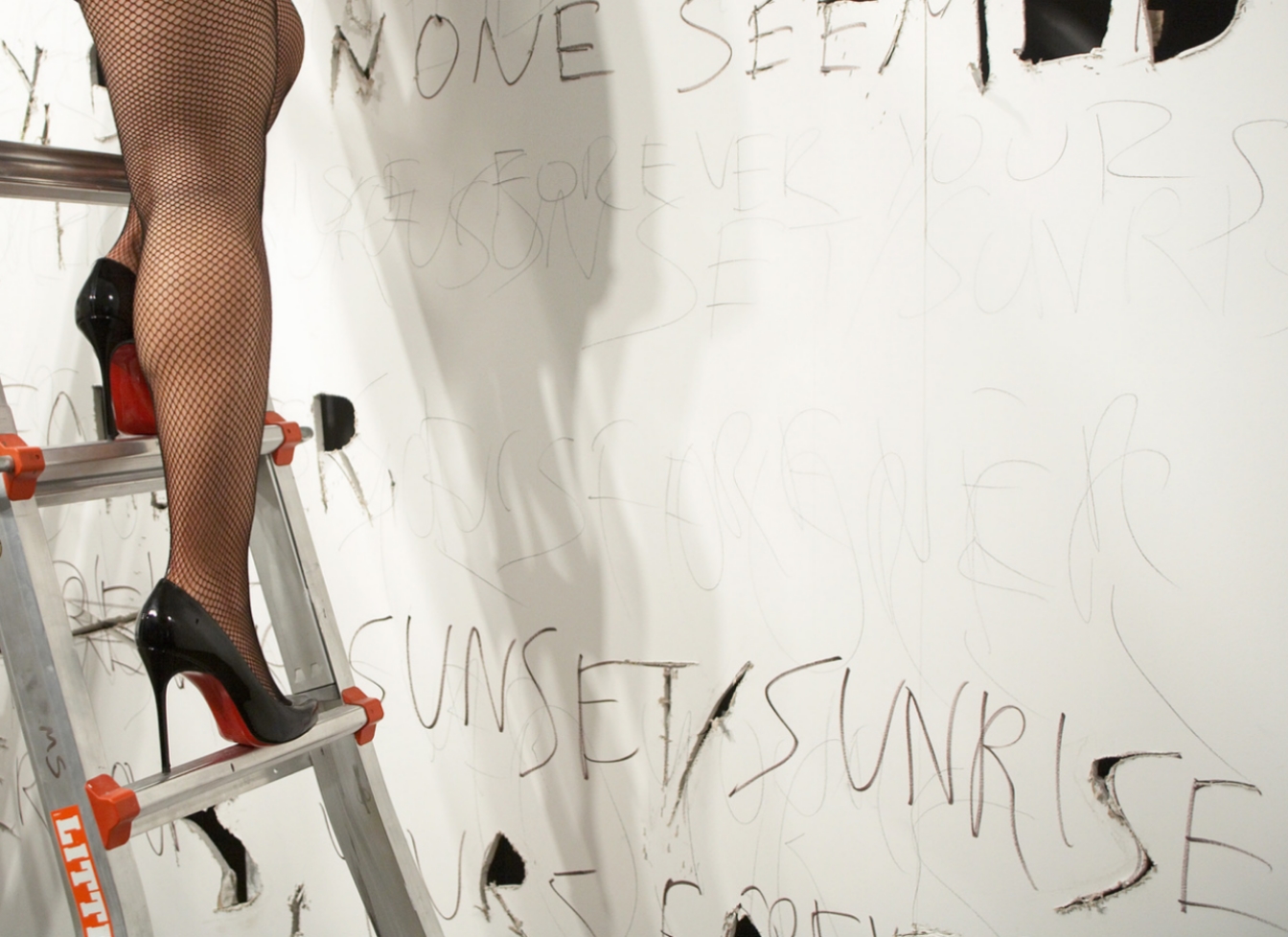
Ladder, Sawzall, Louboutin stilettos, fishnets, lipstick, and silk dress
The demolition of the site-specific piece was the closing event of the solo exhibition Notyetness at bitforms gallery. The demolition was performed for the cameras, to exist publically as documentation.
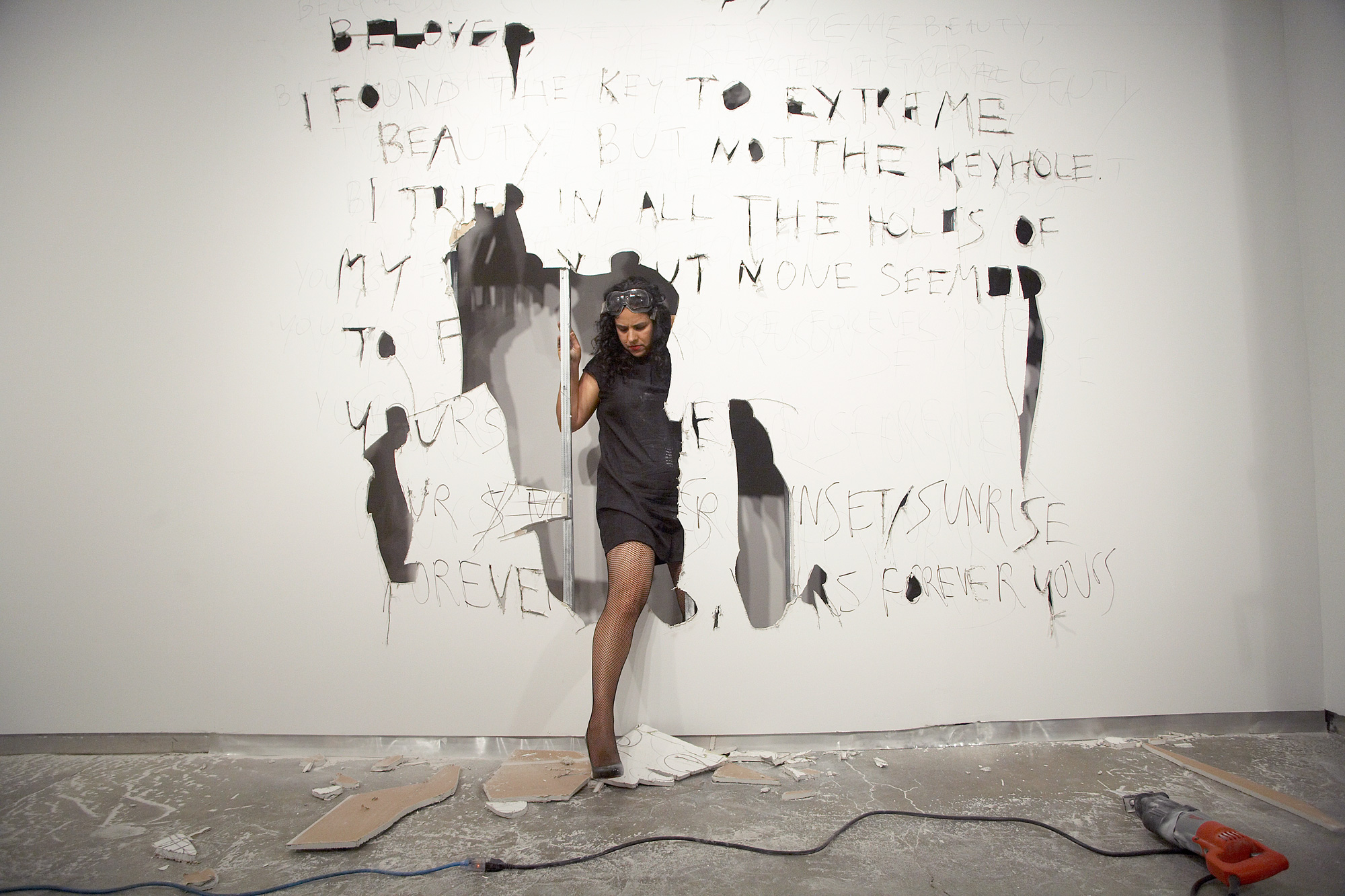
Ladder, Sawzall, Louboutin stilettos, fishnets, lipstick, and silk dress
The demolition of the site-specific piece was the closing event of the solo exhibition Notyetness at bitforms gallery. The demolition was performed for the cameras, to exist publically as documentation.
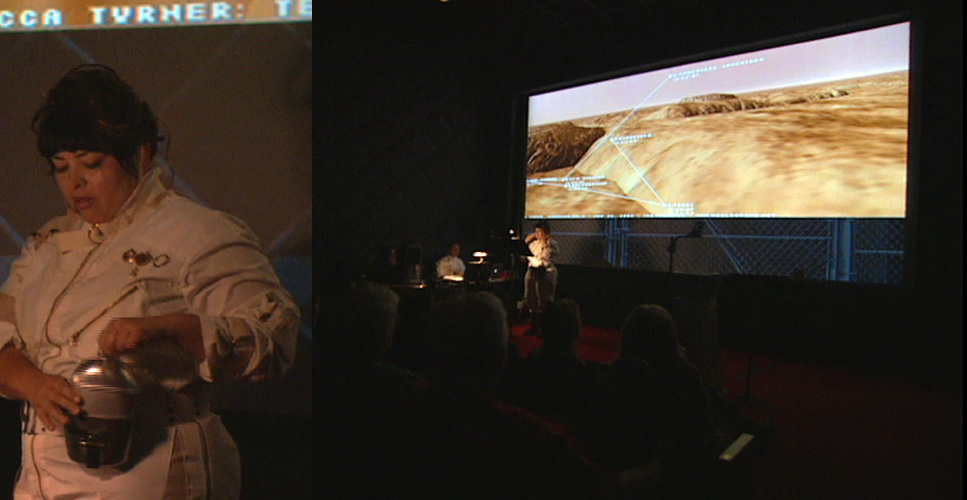
Performance duration: 15 min
The Drawing Center for the "River to River" festival, NYC
Conceived and performed with performance artist Nao Bustamante. Music by Yoav Gal and a dancefilm by Evann Siebens. The program was organized by The Drawing Center for the River to River festival in downtown Manhattan. In addition ot the performance, the program included two video screenings by Shahzia Sikander and William Kentridge.
The performance included two songs and two love letters: Pearl, Conception/Mis, and Portal from the World of Awe: A Traveler's Journal.
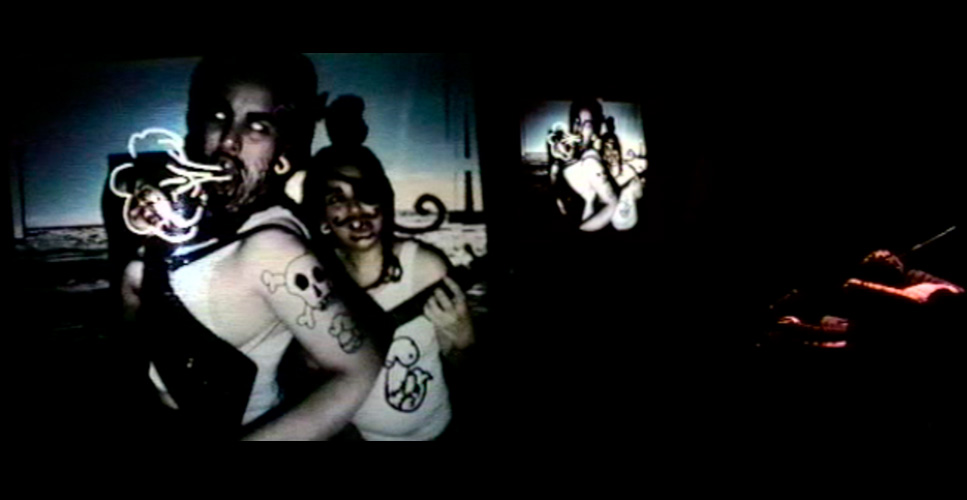
One-person, multimedia performance, including love letters, slides, and song narrated by a single performer seated with her back to the audience.
The performance took place at the The American Living Room, an annual summer festival featuring new works by emerging artists held at HERE, NYC.
Video
2:31 Minutes
Edition of 6, 1 AP
Collection of CU Art Museum, University of Colorado at Boulder
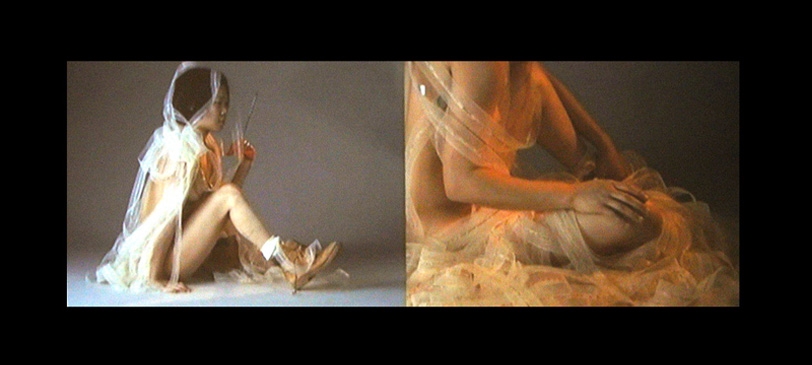
This video artwork simulates a computer process called schedule task. The two screens alternate a simple action. On the left, the User wakes up from sleep mode and is ready for action, on the right, the User taps her knee while singing Ring of Fire by June Carter Cash. The video is a continuous loop.
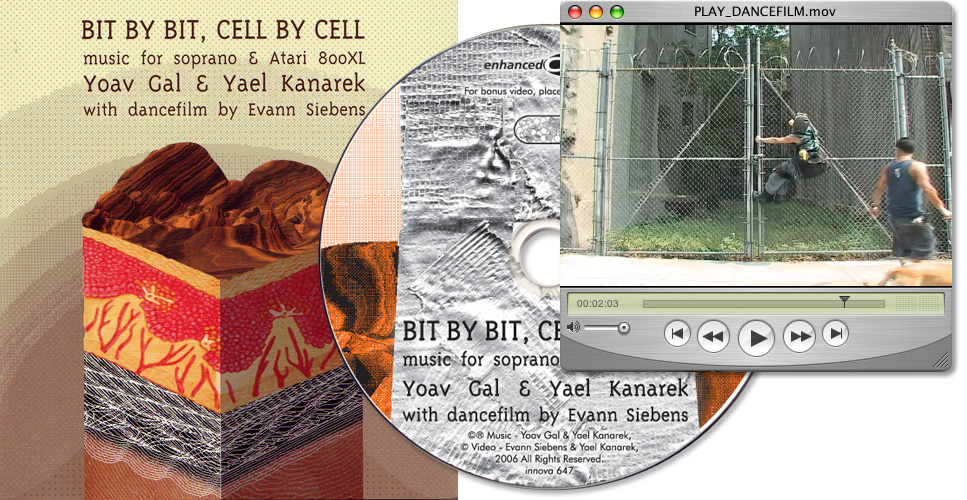
Enhanced Music CD
Innova Recordings
This enhanced CD is the result of a collaboration between composer Yoav Gal and dance filmmaker Evann Siebens. Love letters and travelogs from the Traveler's Journal were set to music. Eleven music tracks alternate between a digitally manipulated soprano (Sarah Rivkin) and instrumental music composed for an Atari 800 XL. The CD is available on Amazon, iTunes, Innova recordings label, Eyebeam's bookstore, and soon here.
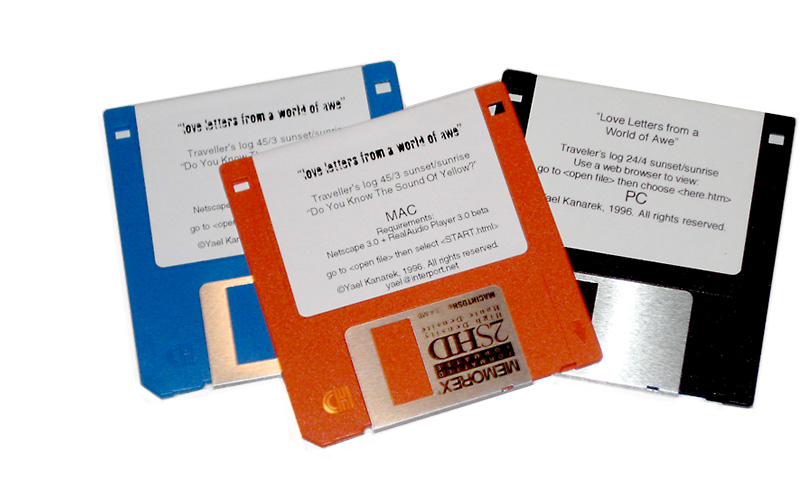
HTML files, jpgs and gifs on floppies
Mac, Netscape 3.0 + RealAudio player
PC native web browser
Edition unknown. A few are available.
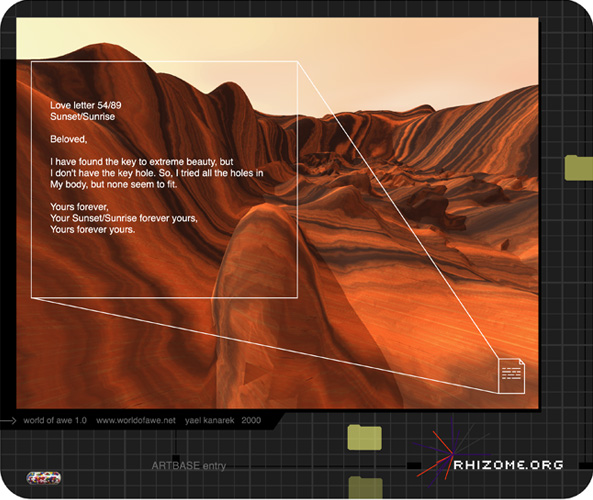
Mouspad
Designed for Rhizome circa 1998
Website
http://www.worldofawe.net/
Forever is the first chapter of World of Awe: A Traveler's Journal. It includes love letters and diary entries, descriptions of navigation tools and treasure hunting equipment. The interface is based by early Mac graphical user interface design and Windows 3.1. Menu standards are appropriated to serves as entry points to this diaristic and epistolary narrative.
Deeply yearning, an anonymous protagonist searches for a lost treasure in a parallel world. The Traveler's Journal employs a nostalgic, solitary voice to meditate on our obsession with digital technology.
Enter Forever
Forever was included in the 2002 Whitney Biennial and was shown on a laptop.